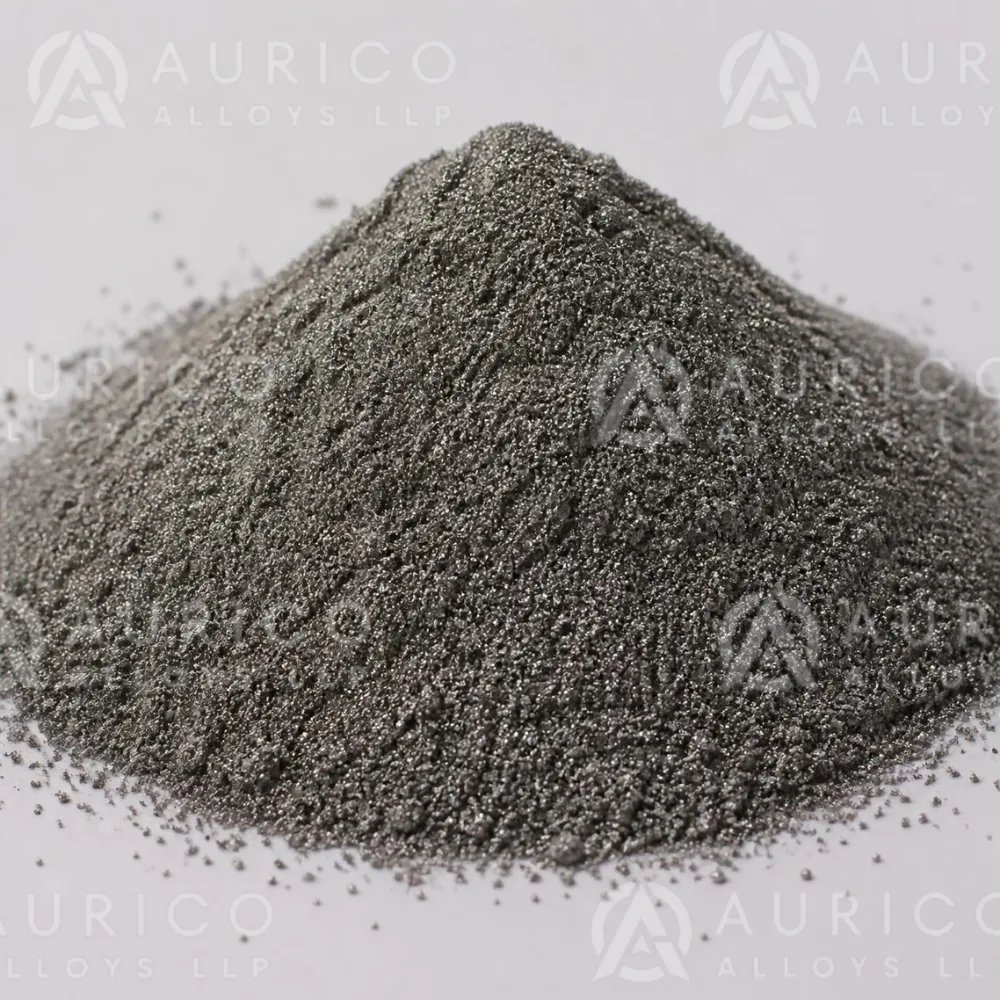
Metal Powders
Aurico Alloys LLP supplies gas and plasma atomised metal powders for additive manufacturing, thermal spray and metal injection moulding, across the nickel superalloy, titanium, cobalt-chrome, stainless and tool steel families.
Powder is bought on three things: the alloy, the particle size cut, and the characterisation data that proves both. Every grade and cut listed below is one we supply - held in stock or arranged with the manufacturer, depending on grade and quantity.
Powder Grades Supplied
| Powder | UNS / designation | Feedstock specification | Size fractions supplied |
|---|---|---|---|
| Inconel® 718 | N07718 | ASTM F3055 (PBF), AMS 5662 / 5663 for the wrought equivalent | 0-15 µm (MIM and binder jetting), 15-45 and 15-53 µm (LPBF), 45-105 and 53-105 µm (EBM and DED), 45-150 and 53-150 µm (DED, cladding and HIP) |
| Inconel 625 | N06625 | ASTM F3056 (PBF), AMS 5599 for the wrought equivalent | 0-15 µm (MIM and binder jetting), 15-45 and 15-53 µm (LPBF), 45-105 and 53-105 µm (EBM and DED), 45-150 and 53-150 µm (DED, cladding and HIP) |
| 316L | S31603 | ASTM F3184 (PBF), ASTM A276 for the wrought equivalent | 0-15 µm (MIM and binder jetting), 15-45 and 15-53 µm (LPBF), 45-105 and 53-105 µm (EBM and DED), 45-150 and 53-150 µm (DED, cladding and HIP) |
| 17-4 PH | S17400 | ASTM F3301 (PBF post-processing), AMS 5643 for the wrought equivalent | 0-15 µm (MIM and binder jetting), 15-45 and 15-53 µm (LPBF), 45-105 and 53-105 µm (EBM and DED), 45-150 and 53-150 µm (DED, cladding and HIP) |
| Maraging 18Ni300 | 1.2709 / X3NiCoMoTi 18-9-5 | Supplied to producer specification; wrought equivalent per DIN 1.2709 | 0-15 µm (MIM and binder jetting), 15-45 and 15-53 µm (LPBF), 45-105 and 53-105 µm (EBM and DED), 45-150 and 53-150 µm (DED, cladding and HIP) |
| H13 | T20813 | ASTM A681 for the wrought equivalent | 0-15 µm (MIM and binder jetting), 15-45 and 15-53 µm (LPBF), 45-105 and 53-105 µm (EBM and DED), 45-150 and 53-150 µm (DED, cladding and HIP) |
| CoCrMo | R31537 / R30075 | ASTM F3213 (PBF), ASTM F75 for the cast equivalent, ISO 5832-4 | 10-30 µm (fine-layer dental LPBF), 15-45 and 15-53 µm (LPBF), 45-105 and 53-105 µm (EBM and DED), 45-150 and 53-150 µm (DED, cladding and HIP) |
| Ti-6Al-4V Grade 5 | R56400 | ASTM F2924 (PBF), ASTM B348 for the wrought equivalent | 0-15 µm (MIM and binder jetting), 10-30 µm (fine-layer LPBF), 15-45 and 15-53 µm (LPBF), 45-105 and 53-105 µm (EBM and DED), 45-150 and 53-150 µm (DED, cladding and HIP) |
| Ti-6Al-4V ELI Grade 23 | R56407 | ASTM F3001 (PBF), ASTM F136 for the wrought implant equivalent, ISO 5832-3 | 0-15 µm (MIM and binder jetting), 10-30 µm (fine-layer LPBF), 15-45 and 15-53 µm (LPBF), 45-105 and 53-105 µm (EBM and DED), 45-150 and 53-150 µm (DED, cladding and HIP) |
| AlSi10Mg | EN AC-43000 equivalent | ASTM F3318 (PBF) | 10-30 µm (fine-layer LPBF), 15-45, 15-53 and 20-63 µm (LPBF), 45-105 and 53-105 µm (EBM and DED), 45-150 and 53-150 µm (DED, cladding and HIP) |
Powder Pages by Alloy Family
- Inconel Powder — Inconel 718, Inconel 625
- Titanium Powder — Ti Grade 2 (CP), Ti-6Al-4V Grade 5, Ti-6Al-4V ELI Grade 23
- Stainless Steel Powder — 316L, 17-4 PH
- Tool Steel Powder — H13, Maraging 18Ni300
- CoCrMo Powder
- AlSi10Mg Powder
Matching the Powder to the Process
Particle size is set by the process, not the alloy. Using the wrong cut is the most common reason a qualified alloy still produces poor parts.
| Process | Particle size | Why |
|---|---|---|
| Laser powder-bed fusion (LPBF / SLM / DMLS) | 10-30 µm, 15-45 µm, 15-53 µm, 20-63 µm | The most common route. Fine, tightly distributed powder for thin layers and good surface finish. Some machine manuals call for a specific cut on a given grade - check yours. |
| Electron beam melting (EBM) | 20-63 µm, 45-105 µm, 53-105 µm | Coarser cut, since finer powder is disturbed by the electron beam charge. |
| Directed energy deposition (DED) and laser cladding | 45-105 µm, 53-105 µm, 45-150 µm, 53-150 µm | Blown powder, so flowability matters more than fineness. |
| Binder jetting | 0-15 µm | Very fine powder for green-part density, sintered after printing. |
| Metal injection moulding (MIM) | 0-15 µm, 15-53 µm | Fine powder for feedstock loading and sintered density. |
| Thermal spray and HVOF | 53-150 µm | Coating applications, where morphology governs deposition efficiency. |
Standard Particle Size Fractions
A sieve fraction is defined by the process it feeds, not by the alloy in it. Every cut below is one we supply - held in stock or arranged with the manufacturer, depending on grade and quantity. Distributions outside these, or tightened within one, are classified to specification.
| Size fraction | Typical applications | Why this cut |
|---|---|---|
| 0-15 µm | Metal injection moulding and binder jetting | The finest cut we hold, and a top cut rather than a band. Suits MIM feedstock loading and binder-jetting green-part density. Not a running size, so it is classified to order and no standard distribution is published for it. |
| 10-30 µm | Fine-layer laser powder-bed fusion, dental | Not a general-purpose cut. Some LPBF machine manuals specify it to get their best result on particular grades; we currently hold it in CoCrMo, Ti-6Al-4V and AlSi10Mg. |
| 15-45 µm | Laser powder-bed fusion | A tighter LPBF cut than 15-53, for thinner layers and finer surface detail. |
| 15-53 µm | Laser powder-bed fusion and metal injection moulding | A slightly wider cut, often used where powder is shared between LPBF and MIM feedstock. |
| 20-63 µm | Laser powder-bed fusion and electron beam melting | The coarsest LPBF cut, and the standard fraction for aluminium alloys. Also runs in EBM. |
| 45-105 µm | Electron beam melting, directed energy deposition, laser cladding | Blown or beam-melted powder needs mass and flowability more than fineness. EBM also needs coarser powder to avoid charge-driven smoke. |
| 53-105 µm | Electron beam melting and directed energy deposition | As 45-105 but with the fines taken out, where flow through the nozzle or hopper matters most. |
| 45-150 µm | Directed energy deposition | Blown powder, where flowability and mass through the nozzle matter more than fineness. |
| 53-150 µm | Thermal spray, HVOF and industrial metallurgy | Coarse fraction for coating processes, where deposition efficiency governs. |
| Custom | Application-specific | Cuts outside the standard fractions, or a tightened distribution within one, sieved and classified to your specification. |
Powder Selection by Manufacturing Process
Not every alloy runs in every process. Aluminium is difficult to blow in directed energy deposition and poor in metal injection moulding; maraging steel is not a thermal spray material; electron beam melting needs a conductive powder and a coarser cut than some grades are made in. Where a route is marked limited it is done, but it is not the normal way that alloy is processed.
| Powder | LPBF | EBM | DED / cladding | MIM | Binder jetting | Thermal spray |
|---|---|---|---|---|---|---|
| Inconel 718 | Yes | Yes | Yes | Yes | Yes | Yes |
| Inconel 625 | Yes | Yes | Yes | Yes | Yes | Yes |
| 316L | Yes | Limited | Yes | Yes | Yes | Yes |
| 17-4 PH | Yes | Limited | Yes | Yes | Yes | Limited |
| Maraging 18Ni300 | Yes | Not applicable | Yes | Limited | Limited | Not applicable |
| H13 | Yes | Not applicable | Yes | Yes | Limited | Yes |
| CoCrMo | Yes | Yes | Yes | Yes | Limited | Yes |
| Ti-6Al-4V Grade 5 | Yes | Yes | Yes | Yes | Limited | Limited |
| Ti-6Al-4V ELI Grade 23 | Yes | Yes | Yes | Yes | Limited | Not applicable |
| AlSi10Mg | Yes | Not applicable | Limited | Limited | Limited | Limited |
Inconel 718 Powder
The most widely printed superalloy in the world. Its sluggish ageing response means a printed part can be stress relieved, HIPed and aged without strain-age cracking.
| Alloy family | Nickel superalloy |
|---|---|
| UNS / designation | N07718 |
| Werkstoff (W.Nr.) | 2.4668 |
| Feedstock specification | ASTM F3055 (PBF), AMS 5662 / 5663 for the wrought equivalent |
| Size fractions | 0-15 µm · 15-45 µm · 15-53 µm · 45-105 µm · 53-105 µm · 45-150 µm · 53-150 µm |
| Most common cut | 45-105 µm (EBM and DED) |
| Production route | Vacuum induction melted, argon gas atomised |
| Composition | Nickel 50-55% with 17-21% chromium, 4.75-5.5% niobium and 2.8-3.3% molybdenum, strengthened by gamma-double-prime on ageing. |
| Typical applications | Turbine wheels, impellers, combustion hardware, downhole tools and high-load aerospace brackets. |
| Post-processing | Stress relief, HIP, solution treatment and double ageing per AMS 5663. |
Inconel 625 Powder
Strengthened as printed rather than by heat treatment, which is why it is the usual choice for corrosion-critical parts and for cladding worn or damaged components.
| Alloy family | Nickel superalloy |
|---|---|
| UNS / designation | N06625 |
| Werkstoff (W.Nr.) | 2.4856 |
| Feedstock specification | ASTM F3056 (PBF), AMS 5599 for the wrought equivalent |
| Size fractions | 0-15 µm · 15-45 µm · 15-53 µm · 45-105 µm · 53-105 µm · 45-150 µm · 53-150 µm |
| Most common cut | 45-105 µm (DED and cladding) |
| Production route | Vacuum induction melted, argon gas atomised |
| Composition | Nickel 58% minimum with 20-23% chromium, 8-10% molybdenum and 3.15-4.15% niobium. Solid-solution strengthened, so no ageing treatment is needed. |
| Typical applications | Seawater and subsea hardware, chemical process components, exhaust and bellows parts, and laser cladding of valve and shaft surfaces. |
| Post-processing | Stress relief and HIP; solution annealing where full corrosion performance is required. |
316L Stainless Steel Powder
The workhorse of metal printing. Forgiving to process, weldable, and cheap enough to use for prototyping before committing to a costlier alloy.
| Alloy family | Austenitic stainless steel |
|---|---|
| UNS / designation | S31603 |
| Werkstoff (W.Nr.) | 1.4404 |
| Feedstock specification | ASTM F3184 (PBF), ASTM A276 for the wrought equivalent |
| Size fractions | 0-15 µm · 15-45 µm · 15-53 µm · 45-105 µm · 53-105 µm · 45-150 µm · 53-150 µm |
| Most common cut | 45-105 µm (DED) |
| Production route | Argon or nitrogen gas atomised |
| Composition | 16-18% chromium, 10-14% nickel and 2-3% molybdenum with carbon held to 0.03% maximum, which is what the L designates. |
| Typical applications | Medical and surgical instruments, food and pharmaceutical process parts, marine fittings, and heat exchangers. |
| Post-processing | Stress relief; solution annealing where maximum corrosion resistance or ductility is needed. |
17-4 PH Stainless Steel Powder
Reaches over 1300 MPa after a simple H900 age, which makes it the default when a printed stainless part has to carry real load.
| Alloy family | Precipitation-hardening stainless steel |
|---|---|
| UNS / designation | S17400 |
| Werkstoff (W.Nr.) | 1.4542 |
| Feedstock specification | ASTM F3301 (PBF post-processing), AMS 5643 for the wrought equivalent |
| Size fractions | 0-15 µm · 15-45 µm · 15-53 µm · 45-105 µm · 53-105 µm · 45-150 µm · 53-150 µm |
| Production route | Argon or nitrogen gas atomised |
| Composition | 15-17.5% chromium, 3-5% nickel and 3-5% copper with niobium. Copper precipitation on ageing is what produces the strength. |
| Typical applications | Tooling, aerospace brackets, valve and pump components, and moulds. |
| Post-processing | Solution treat then age - H900 for maximum strength, H1025 or H1150 where toughness matters more. |
Maraging Steel Powder (18Ni300)
Prints soft and ages to over 1900 MPa in a single low-temperature step, with almost no distortion. That combination is why injection mould tooling is printed in it.
| Alloy family | Maraging tool steel |
|---|---|
| UNS / designation | 1.2709 / X3NiCoMoTi 18-9-5 |
| Werkstoff (W.Nr.) | 1.2709 |
| Feedstock specification | Supplied to producer specification; wrought equivalent per DIN 1.2709 |
| Size fractions | 0-15 µm · 15-45 µm · 15-53 µm · 45-105 µm · 53-105 µm · 45-150 µm · 53-150 µm |
| Production route | Vacuum induction melted, argon gas atomised |
| Composition | 18% nickel with 9% cobalt and 5% molybdenum, and carbon kept very low. Strength comes from intermetallic precipitation, not from carbon. |
| Typical applications | Injection mould inserts with conformal cooling, die-casting tooling, and high-strength aerospace hardware. |
| Post-processing | Solution anneal then age at approximately 490 degrees C for 6 hours. |
H13 Tool Steel Powder
Holds hardness at temperature and resists thermal fatigue, so it survives the heat-and-quench cycling that destroys ordinary tool steel in die casting.
| Alloy family | Hot-work tool steel |
|---|---|
| UNS / designation | T20813 |
| Werkstoff (W.Nr.) | 1.2344 |
| Feedstock specification | ASTM A681 for the wrought equivalent |
| Size fractions | 0-15 µm · 15-45 µm · 15-53 µm · 45-105 µm · 53-105 µm · 45-150 µm · 53-150 µm |
| Most common cut | 45-105 µm (DED and cladding) |
| Production route | Argon gas atomised |
| Composition | 4.75-5.5% chromium with 1.1-1.75% molybdenum and 0.8-1.2% vanadium, at 0.32-0.45% carbon. |
| Typical applications | Die-casting dies, hot forging tooling, extrusion dies, and repair cladding of worn tool surfaces. |
| Post-processing | Preheated build plate to control cracking, then austenitise, quench and double temper. |
CoCrMo Powder
Combines biocompatibility with wear resistance no titanium alloy can match, which is why load-bearing articulating surfaces are made from it rather than Ti-6Al-4V.
| Alloy family | Cobalt-chromium alloy |
|---|---|
| UNS / designation | R31537 / R30075 |
| Werkstoff (W.Nr.) | 2.4723 |
| Feedstock specification | ASTM F3213 (PBF), ASTM F75 for the cast equivalent, ISO 5832-4 |
| Size fractions | 10-30 µm · 15-45 µm · 15-53 µm · 45-105 µm · 53-105 µm · 45-150 µm · 53-150 µm |
| Most common cut | 45-105 µm (EBM) |
| Production route | Vacuum induction melted, argon gas atomised |
| Composition | 26-30% chromium and 5-7% molybdenum over a cobalt balance, with carbon, nickel and iron closely controlled for implant use. |
| Typical applications | Hip and knee implants, dental frameworks and crowns, and wear-resistant industrial components. |
| Post-processing | HIP and solution annealing; implant work adds surface finishing to the applicable ISO standard. |
Titanium Grade 5 Powder (Ti-6Al-4V)
The most used titanium alloy in manufacturing, and the reason printed titanium parts exist at all: roughly the strength of steel at 60% of the weight.
| Alloy family | Alpha-beta titanium alloy |
|---|---|
| UNS / designation | R56400 |
| Werkstoff (W.Nr.) | 3.7165 |
| Feedstock specification | ASTM F2924 (PBF), ASTM B348 for the wrought equivalent |
| Size fractions | 0-15 µm · 10-30 µm · 15-45 µm · 15-53 µm · 45-105 µm · 53-105 µm · 45-150 µm · 53-150 µm |
| Most common cut | 45-105 µm (EBM) |
| Production route | Plasma atomised or plasma rotating electrode, for sphericity and low satellite content |
| Composition | 5.5-6.75% aluminium and 3.5-4.5% vanadium, with oxygen to 0.20% maximum. |
| Typical applications | Aerospace structure and brackets, motorsport components, marine hardware and industrial tooling. |
| Post-processing | Stress relief in vacuum or argon, then HIP to close internal porosity for fatigue-critical parts. |
Titanium Grade 23 Powder (Ti-6Al-4V ELI)
Those tighter interstitial limits buy fracture toughness and ductility, which is what makes it the implant grade rather than Grade 5.
| Alloy family | Alpha-beta titanium alloy, extra low interstitial |
|---|---|
| UNS / designation | R56407 |
| Werkstoff (W.Nr.) | 3.7165 |
| Feedstock specification | ASTM F3001 (PBF), ASTM F136 for the wrought implant equivalent, ISO 5832-3 |
| Size fractions | 0-15 µm · 10-30 µm · 15-45 µm · 15-53 µm · 45-105 µm · 53-105 µm · 45-150 µm · 53-150 µm |
| Most common cut | 45-105 µm (EBM) |
| Production route | Plasma atomised or plasma rotating electrode |
| Composition | The Grade 5 composition with interstitials tightened - oxygen to 0.13%, iron to 0.25% and carbon to 0.08% maximum. |
| Typical applications | Orthopaedic and spinal implants, trauma fixation, dental, and cryogenic or damage-tolerant aerospace parts. |
| Post-processing | Stress relief and HIP; implant work adds surface treatment and cleaning to the applicable ISO standard. |
AlSi10Mg Powder
The aluminium alloy that actually prints well. Rapid solidification in LPBF produces a much finer structure than casting, so printed properties exceed the cast equivalent.
| Alloy family | Aluminium casting alloy |
|---|---|
| UNS / designation | EN AC-43000 equivalent |
| Werkstoff (W.Nr.) | 3.2381 |
| Feedstock specification | ASTM F3318 (PBF) |
| Size fractions | 10-30 µm · 15-45 µm · 15-53 µm · 20-63 µm · 45-105 µm · 53-105 µm · 45-150 µm · 53-150 µm |
| Production route | Nitrogen or argon gas atomised |
| Composition | 9-11% silicon with 0.2-0.45% magnesium. The near-eutectic silicon content is what gives it the fluidity and narrow freezing range that suit a melt pool. |
| Typical applications | Lightweight structural parts, heat exchangers and cold plates, automotive and motorsport components, and housings. |
| Post-processing | Stress relief at approximately 300 degrees C; T6 where higher strength is required. |
Characterisation and Certification
Every batch is supplied with chemical analysis, particle size distribution by laser diffraction to ASTM B822, apparent and tap density, and flow rate by Hall or Carney funnel. Morphology imaging, oxygen and nitrogen analysis and reporting to ISO/ASTM 52907 are available where your qualification requires them.
Powder is packed under argon in sealed containers with desiccant, and labelled with lot number, alloy, particle size cut and date of atomisation. Implant-grade material carries the traceability its standard requires.
Frequently Asked Questions
Request a Quotation
Send the alloy, the particle size cut, the process you are running and the quantity, and we will quote with lead time and the characterisation data you need. Call +91 7977 88 6611 or email info@auricoalloys.com.
Minimum order 5 kg · Lead time 7 days from order confirmation.