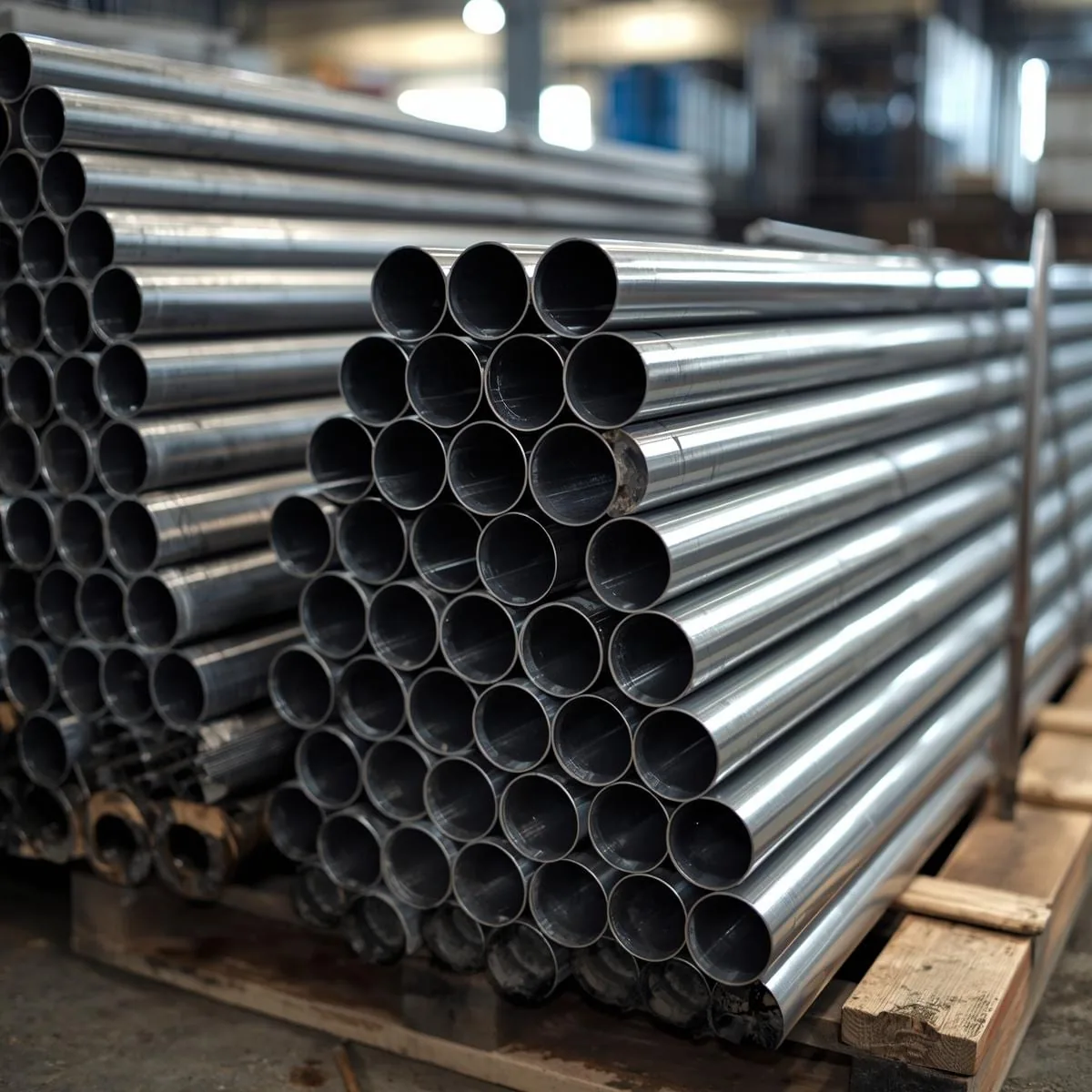
Duplex Steel Tube for Corrosion Resistance, Higher Strength, and Demanding Industrial Service
Table of Contents:
For industrial buyers comparing tubing materials before purchase, Duplex Steel Tube offers a practical balance of corrosion resistance, chloride stress corrosion cracking resistance, and roughly double the yield strength of common austenitic stainless steels in many service conditions.
Why buyers move to duplex tubing
In aggressive plants and offshore systems, failures often begin quietly with pitting, crevice corrosion, erosion-fatigue, or chloride stress corrosion cracking rather than a sudden visible break, and those hidden mechanisms can turn into shutdowns, leakage, or premature replacement costs.
That is where Duplex Steel Tube becomes commercially attractive: it combines a ferritic-austenitic microstructure with higher strength and better localized corrosion resistance than grades such as 316L or 317L in many corrosive environments.
Alloy 2205 in particular is described as having pitting and crevice corrosion resistance superior to 316L or 317L in almost all corrosive media, while also offering lower thermal expansion and higher thermal conductivity than austenitic stainless steels.
Specifications and standards
Duplex Steel Tube is commonly supplied under ASTM and ASME standards such as ASTM A789 for seamless and welded ferritic-austenitic stainless steel tubing and ASTM A790 for ferritic-austenitic stainless steel pipe, with project documentation often carrying the equivalent ASME SA references.
Standard duplex grades include UNS S31803 and UNS S32205, while super duplex grades commonly include UNS S32750 and UNS S32760 for more severe chloride and offshore environments.
European and German references frequently used in procurement include EN 1.4462 / DIN W.Nr. 1.4462 for Duplex 2205 and EN 1.4410 / DIN 1.4410 for Super Duplex 2507, which helps buyers align international specifications across EPC, OEM, and export documentation.
| Grade | UNS | Common ASTM / ASME | DIN / EN Reference |
|---|---|---|---|
| Duplex 2205 | UNS S31803 / UNS S32205 | ASTM A789, ASTM A790 / ASME SA789, SA790 | EN 1.4462, DIN W.Nr. 1.4462 |
| Super Duplex 2507 | UNS S32750 | ASTM A789, ASTM A790 | EN 1.4410, DIN 1.4410 |
| Super Duplex | UNS S32760 | ASTM A789, ASTM A790 | Commercial EN / DIN mapping varies by producer and project |
| Price | INR 800 – 2,000 per kg. Indicative USD 9 – 24 per kg; quoted against grade, form, size and quantity. |
Specifications by Grade – Pipe and tube
A specification is written for a product form. The standards below are the ones that cover pipe and tube; the plate, bar and tube specifications for these grades are different documents and are listed on their own pages.
| Grade | UNS | Pipe and tube specification |
|---|---|---|
| 2205 | S32205 | ASTM A790 / A789 |
| 32750 | S32750 | ASTM A790 / A789 |
| 32760 | S32760 | ASTM A790 / A789 |
Equivalent grades and grade selection
For most industrial buyers, Duplex 2205 is the benchmark general-purpose duplex grade, while Super Duplex 2507 and S32760 are selected when chloride, seawater, brine, or highly aggressive media demand even greater pitting and crevice corrosion resistance.
Commercially, UNS S31803 and UNS S32205 are closely linked, and recent production of S31803 is often made to comply with S32205 limits, which helps procurement teams simplify approval when tighter chemistry control is required.
Typical buyer positioning
- UNS S31803 / S32205: selected for broad chemical, oil and gas, and structural tubing service with good corrosion resistance and high strength.
- UNS S32750: selected for more severe chloride, marine, and offshore conditions with stronger resistance to localized corrosion.
- UNS S32760: selected where specific acid or brine environments benefit from controlled copper and tungsten additions.
Product forms and availability
Duplex Steel Tube is commercially available in seamless and welded forms, and the broader duplex family is also supplied as pipes, fittings, flanges, plates, bars, and fabricated components for complete project packages.
ASTM A789 is particularly relevant when the requirement is tube rather than pipe, which matters for heat exchangers, instrumentation lines, condensers, cooling systems, and OEM-built assemblies where dimensional accuracy and clean internal finish are critical.
Where an assembly also includes machined supports or forged connecting parts, buyers may naturally pair the tubing package with a related product such as duplex steel hex bars for fittings, fasteners, and fabrication hardware.
Chemical composition
The corrosion performance of duplex tubing comes from a balanced chemistry built around chromium, molybdenum, nickel, and nitrogen, which together help improve pitting resistance, crevice corrosion resistance, and overall phase balance.
| Element | Duplex 2205 Typical Composition | Super Duplex 2507 Typical Composition |
|---|---|---|
| Carbon (C) | 0.020 typical, 0.030 max range in standards | Low carbon, controlled for corrosion performance |
| Chromium (Cr) | About 22.1 typical; commonly 22.0 - 23.0% | 24 - 26% |
| Nickel (Ni) | About 5.6 typical; commonly 4.5 - 6.5% | 6 - 8% |
| Molybdenum (Mo) | About 3.1 typical; commonly 3.0 - 3.5% | 3 - 5% |
| Nitrogen (N) | About 0.18 typical; commonly 0.14 - 0.20% | 0.24 - 0.32% |
| Iron (Fe) | Balance | Balance |
For Duplex 2205, the PREN formula is shown as at least 34 in the technical sheet, which helps explain its strong resistance to localized corrosion compared with common austenitic stainless grades.
Mechanical and physical properties
One of the strongest commercial arguments for Duplex Steel Tube is strength: the 2205 specification sheet states that yield strength is about twice that of austenitic stainless steels, which can allow lighter wall selection or better mechanical margin in design.
For ASTM A240-based 2205 data in the solution-annealed condition, the sheet lists minimum yield strength of 65 ksi, minimum tensile strength of 90 ksi, and minimum elongation of 25%, with typical values of 74 ksi yield, 105 ksi tensile, and 30% elongation.
| Property | Duplex 2205 / Super Duplex Reference Value |
|---|---|
| Yield Strength (2205) | 65 ksi minimum, 74 ksi typical |
| Tensile Strength (2205) | 90 ksi minimum, 105 ksi typical |
| Elongation (2205) | 25% minimum, 30% typical |
| Hardness (2205) | 32 HRC maximum, 19 HRC typical in cited sheet |
| Density (2205 / 2507) | About 7.8 g/cm³ |
| Thermal Expansion | Lower than austenitic stainless steel for 2205 |
| Recommended Service Range | 2205 is particularly suitable from about -50°F to +600°F in cited sheet |
What these numbers mean for buyers
Higher strength can reduce weight and improve competitiveness in structural or pressure-containing service, while lower thermal expansion and stronger resistance to chloride cracking add reliability in fluctuating industrial environments.
Applications by industry
Chemical processing
Alloy 2205 is cited for pressure vessels, tanks, piping, and heat exchangers in the chemical processing industry because it combines corrosion resistance with mechanical strength in aggressive media.
Oil & Gas
Duplex tubing is widely used for handling gas and oil, offshore exploration, refining, and production systems because the duplex microstructure improves resistance to chloride stress corrosion cracking and supports higher mechanical loads.
Marine
Marine buyers choose duplex and super duplex grades for cooling pipes, cargo tanks, seawater-related systems, and offshore components where pitting and crevice corrosion must be controlled more effectively than with standard stainless grades.
Pharma
In pharmaceutical and clean-process systems, duplex tube is considered where high strength, weldability, and better localized corrosion resistance help maintain long service life in process skids, heat exchangers, and utility lines.
Power generation
Power generation and pollution-control systems use duplex tubing in heat exchangers, scrubbers, and condensate-related systems because of its useful combination of corrosion resistance, erosion-fatigue performance, and structural efficiency.
OEM manufacturers, fabricators, and industrial supply chains
OEM manufacturers and fabricators value duplex steel tube because it is weldable and mechanically strong, while procurement heads and industrial supply stores benefit from globally recognized UNS, ASTM, DIN, and EN identifiers that simplify cross-border sourcing and technical approvals.
Comparison with commonly used grades
Most buyers comparing Duplex Steel Tube evaluate it against 304L, 316L, 317L, and super duplex alternatives to decide whether the increase in strength and corrosion performance justifies the material upgrade.
| Material | Main Advantage | Main Limitation | Typical Buyer Decision |
|---|---|---|---|
| 304L Stainless Steel | Lower initial cost and broad availability | Much lower resistance to chloride stress corrosion cracking and lower strength than duplex in harsh service | Chosen for mild environments and standard utility service |
| 316L / 317L Stainless Steel | Well known for corrosion resistance and ease of fabrication | 2205 offers superior pitting and crevice corrosion resistance plus roughly double yield strength in many cases | Chosen when chloride severity and stress are moderate |
| Duplex 2205 | High strength, good weldability, and strong corrosion resistance | Temperature use is more restricted than some fully austenitic grades, especially for welded structures above the recommended range | Chosen as the default premium duplex grade for broad industrial use |
| Super Duplex 2507 / S32760 | Higher resistance to chloride pitting and crevice attack in severe service | Higher cost and more selective use case | Chosen for offshore, brine, and highly aggressive marine or process duty |
In practical procurement terms, Duplex 2205 is often the best balance point, while super duplex is reserved for environments where the corrosion penalty of choosing a lower grade would be too expensive.
EEAT signals: certifications, testing, and export readiness
Because duplex performance depends on both chemistry and microstructure, serious buyers look for more than a nominal grade name; they want traceability, correct ferrite-austenite balance, and evidence that harmful intermetallic phases have been controlled.
The 2205 specification sheet specifically notes ASTM A923 as a test route for absence of intermetallic phases, and it also emphasizes proper solution annealing and rapid cooling to restore phase balance, toughness, and corrosion resistance after hot forming.
What buyers typically verify
- Mill test certificate with UNS, ASTM / ASME, DIN, and EN references where required.
- Chemical composition, ferrite balance, and heat-treatment condition.
- Hydrostatic, PMI, dimensional, hardness, and project-specific non-destructive testing where applicable.
- Export-ready packing, marking, and EN-style certification documentation for EPC and international orders.
Industry context and light market insight
Demand for duplex tube remains strong because industries such as oil and gas, chemical processing, marine systems, and pollution-control equipment continue to prioritize materials that can reduce corrosion risk without the full cost jump to higher nickel alloys.
Another practical driver is design efficiency: the cited 2205 data shows yield strength about twice that of austenitic stainless steels, which can translate into lighter structures or more robust tubing performance in demanding applications.
When project packages also include machined fastening or connector hardware, some buyers extend the same material family into related products such as duplex hex bars for compatibility across fabricated assemblies.
Frequently asked questions
Global Export Destinations
We ship worldwide from Mumbai. See every destination we export to on our export markets page.
Domestic Supply Network
We deliver across India from our Mumbai stockyard. See every city we supply on our supply locations page.
Conclusion
Duplex Steel Tube gives buyers a strong technical and commercial middle ground between conventional stainless steels and more expensive high-nickel alloys, especially where chloride exposure, strength demands, and lifecycle reliability all matter at the same time.
If your next application must resist corrosion better than 316L while also delivering higher strength and dependable long-term value, isn’t Duplex Steel Tube the material you should be specifying first?