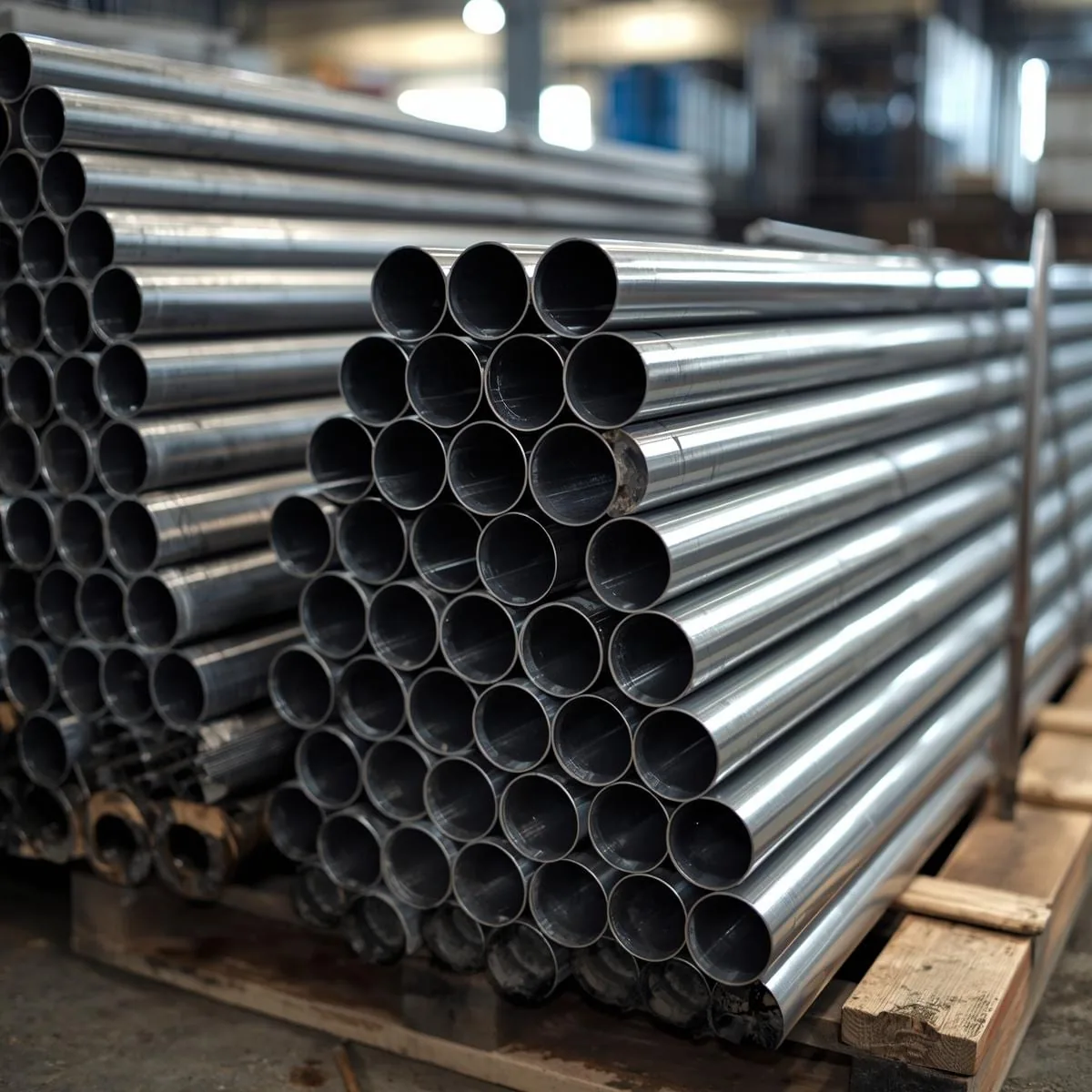
Nimonic® Pipes for High-Temperature, Creep-Resistant, and Reliability-Critical Industrial Service
Table of Contents:
Many high-temperature failures do not begin with instant rupture; they start with creep deformation, stress-rupture damage, oxidation scaling, or metallurgical instability that slowly reduces confidence in tubes and pipes exposed to constant thermal load.
That pattern is why engineers in turbines, hot gas handling, and severe thermal-process systems shift toward Nimonic alloys when the service demands strength retention and oxidation resistance at temperatures where common stainless grades begin to lose margin.
Nimonic 80A and Nimonic 90 are especially noted for creep resistance and high-temperature strength, while Nimonic 75 remains a proven oxidation-resistant alloy for hot-section service.
Specifications and standards
Nimonic® Pipes are typically specified through a combination of UNS grade, trade-name alloy identity, tube or pipe standard, and heat-treatment condition because performance depends heavily on precipitation hardening and service temperature expectations.
DIN and Werkstoff references commonly associated with the Nimonic family include W.Nr. 2.4951 and 2.4630 for Nimonic 75, W.Nr. 2.4631 for Nimonic 80A, and trade-linked material references such as 2.4969 for Nimonic 90 in commercial supply documentation.
| Grade | UNS | Common ASTM / ASME Reference | DIN / EN Reference |
|---|---|---|---|
| Nimonic 75 | UNS N06075 | Commercial supply may reference ASTM B407 / ASME SB407 depending on form | W.Nr. 2.4951 / 2.4630 |
| Nimonic 80A | UNS N07080 | Tube and pipe supply is often project- or mill-specification based | W.Nr. 2.4631 |
| Nimonic 90 | UNS N07090 | ASTM B463 / ASME SB463 cited in commercial tube supply | Trade-linked DIN / EN references vary by supplier and form |
Specifications by Grade – Pipe and tube
A specification is written for a product form. The standards below are the ones that cover pipe and tube; the plate, bar and tube specifications for these grades are different documents and are listed on their own pages.
| Grade | UNS | Pipe and tube specification |
|---|---|---|
| 75 | N06075 | BS HR 403 / DIN 17751 |
| 80A | N07080 | BS HR 401 |
| 81 | — | Mill specification |
| 90 | N07090 | BS HR 402 |
| 263 | N07263 | BS HR 404 / DIN 17751 |
Equivalent grades and grade positioning
Buyers usually compare Nimonic grades by the combination of temperature, stress, and oxidation duty rather than by chemistry alone: Nimonic 75 for oxidation-resistant service, Nimonic 80A for precipitation-hardened strength with lower cobalt content, and Nimonic 90 for higher stress-rupture capability in hotter sections.
Nimonic 80A is also known commercially as Nicrofer 7520 Ti, Pyromet 80A, Superimphy 80A, and Udimet 80A, which matters when procurement teams compare legacy drawings, export papers, and mill certificates from different markets.
How buyers typically shortlist them
- Nimonic 75: selected for high-temperature oxidation resistance and stable hot-service performance.
- Nimonic 80A: chosen for creep strength, oxidation resistance, and long-term thermal duty to about 815°C.
- Nimonic 90: preferred where stress-rupture strength and creep resistance are required up to about 920°C.
Product forms and availability
Nimonic® Pipes are commercially available in seamless, welded, instrumentation, polished, annealed and pickled, bright-annealed, and mill-finish forms, depending on the grade and project requirement.
Typical supply descriptions for Nimonic 90 include single random, double random, standard, and cut lengths, while the broader Nimonic family is also stocked in related product forms such as tubes, sheets, plates, bars, and forged sections for fabrication-driven applications.
Where a project needs matched machinable accessories, fabricators often pair the piping package with a compatible product such as Nimonic hex bars for high-temperature fasteners, stems, collars, or support hardware used in the same hot-zone assembly.
Chemical composition
Among the commercially compared grades, Nimonic 80A is one of the most useful reference points because its chemistry clearly shows how aluminum and titanium are added to a nickel-chromium base to make the alloy precipitation hardenable.
| Element | Nimonic 80A Typical Limits |
|---|---|
| Nickel (Ni) | Balance |
| Chromium (Cr) | Approx. 18.0% - 21.0% |
| Titanium (Ti) | Approx. 1.8% - 2.7% |
| Aluminum (Al) | Approx. 1.0% - 1.8% |
| Cobalt (Co) | Approx. up to 2.0% in cited sheet data |
| Iron (Fe) | Approx. up to 3.0% |
| Carbon, Silicon, Copper, Manganese, Boron, Zirconium, Sulfur | Controlled in small limits to support hot-strength performance |
This chemistry matters because the gamma-prime strengthening response produced by aluminum and titanium is central to the alloy’s high-temperature strength retention under continuous stress.
Mechanical and physical properties
Nimonic 80A is commonly cited with tensile strength below 1000 N/mm² in the annealed condition and around 1200 to 1400 N/mm² after aging, showing why heat treatment and supply condition must be clearly defined before comparing quotations.
Another commercial technical data source lists Alloy 80A in the solution-annealed and precipitation-treated condition at about 145 ksi ultimate tensile strength, 90 ksi yield strength, 20% elongation, and minimum 300 HV hardness, reinforcing its position as a hot-strength structural alloy rather than a simple corrosion alloy.
Nimonic 90 is described in trade data as a precipitation-hardenable nickel-chromium-cobalt alloy with strong creep resistance and stress-rupture strength up to about 1700°F or 920°C, making it especially relevant for turbine-adjacent duty.
| Property | Nimonic Reference Value |
|---|---|
| Nimonic 80A Tensile Strength, Annealed | Below 1000 N/mm² |
| Nimonic 80A Tensile Strength, Aged | 1200 - 1400 N/mm² |
| Nimonic 80A UTS, precipitation treated | 145 ksi |
| Nimonic 80A Yield Strength | 90 ksi |
| Nimonic 80A Elongation | 20% |
| Nimonic 90 Temperature Capability | Up to about 920°C / 1700°F in cited trade data |
| Nimonic 90 Density | 8.18 g/cm³ |
Why this matters to buyers
For procurement heads and design engineers, the key commercial insight is that Nimonic alloys are bought for retained properties at temperature, not just room-temperature strength, so service condition and heat-treatment status must always be reviewed before approval.
Comparison with commonly used grades
Most buyers compare Nimonic against stainless steel, Inconel, and other nickel superalloys to determine whether the service truly demands precipitation-hardened hot-strength performance.
| Material | Main Advantage | Main Limitation | Typical Buyer Decision |
|---|---|---|---|
| 304 / 316 Stainless Steel | Lower cost and easier general-purpose procurement | Much lower hot-strength and creep resistance in severe thermal duty than Nimonic | Used when the line is not exposed to extreme heat or continuous stress |
| Inconel Family | Broad high-temperature and corrosion capability across many grades | Not every grade is optimized specifically for the same precipitation-hardened creep profile as Nimonic 80A or 90 | Chosen when corrosion and fabrication flexibility outweigh the need for a Nimonic-specific hot-strength profile |
| Nimonic 80A / 90 | Strong retained strength, creep resistance, and oxidation stability in high-temperature service | Higher cost and more condition-sensitive specification than commodity materials | Chosen when long service at high temperature is the core requirement |
In practical buying terms, Nimonic becomes the right answer when the penalty of thermal failure is high and the application demands a more specialized high-temperature alloy than general-purpose stainless or standard nickel grades can offer.
EEAT signals: testing, compliance, and export readiness
Because Nimonic performance depends strongly on chemistry, heat treatment, and condition, experienced buyers expect more than a basic invoice description; they want mill documentation that clearly confirms the alloy identity and delivery state.
Typical confidence signals include mill test certificates, heat number traceability, mechanical-property verification, dimensional inspection, hardness checks, and where project-critical, third-party inspection or additional non-destructive examination.
What procurement teams usually verify
- UNS grade and any DIN / W.Nr. equivalence on the test certificate.
- Heat-treatment condition, because aging and precipitation hardening directly influence strength.
- Dimensional conformity, surface finish, and traceability for export projects.
- Third-party inspection or customer witness inspection for critical hot-service orders.
Industry context and commercial relevance
Nimonic is a niche alloy family, but that is exactly why it stays relevant: it serves the small but critical set of applications where temperature, stress, and operating consequence make generic alloys too risky.
In power generation and thermal engineering, even a modest reduction in unplanned shutdown risk can justify a premium alloy decision, especially when replacement access, downtime cost, and safety exposure are high.
Where the design also includes hot-strength fasteners or machined supports, buyers may pair the pipe requirement with a related product such as Inconel hex bars or Nimonic hex bars for material compatibility within the same assembly.
Frequently asked questions
Global Export Destinations
We ship worldwide from Mumbai. See every destination we export to on our export markets page.
Domestic Supply Network
We deliver across India from our Mumbai stockyard. See every city we supply on our supply locations page.
Conclusion
Nimonic® Pipes are not a commodity choice; they are a specialist answer for buyers who need proven high-temperature strength, creep resistance, oxidation stability, and traceable alloy performance in applications where failure is too expensive to risk.
If your next project involves sustained heat, cyclic stress, turbine-adjacent duty, or thermal-process reliability, wouldn’t it be worth specifying a pipe alloy designed to keep its strength when ordinary materials begin to creep, scale, or fail?