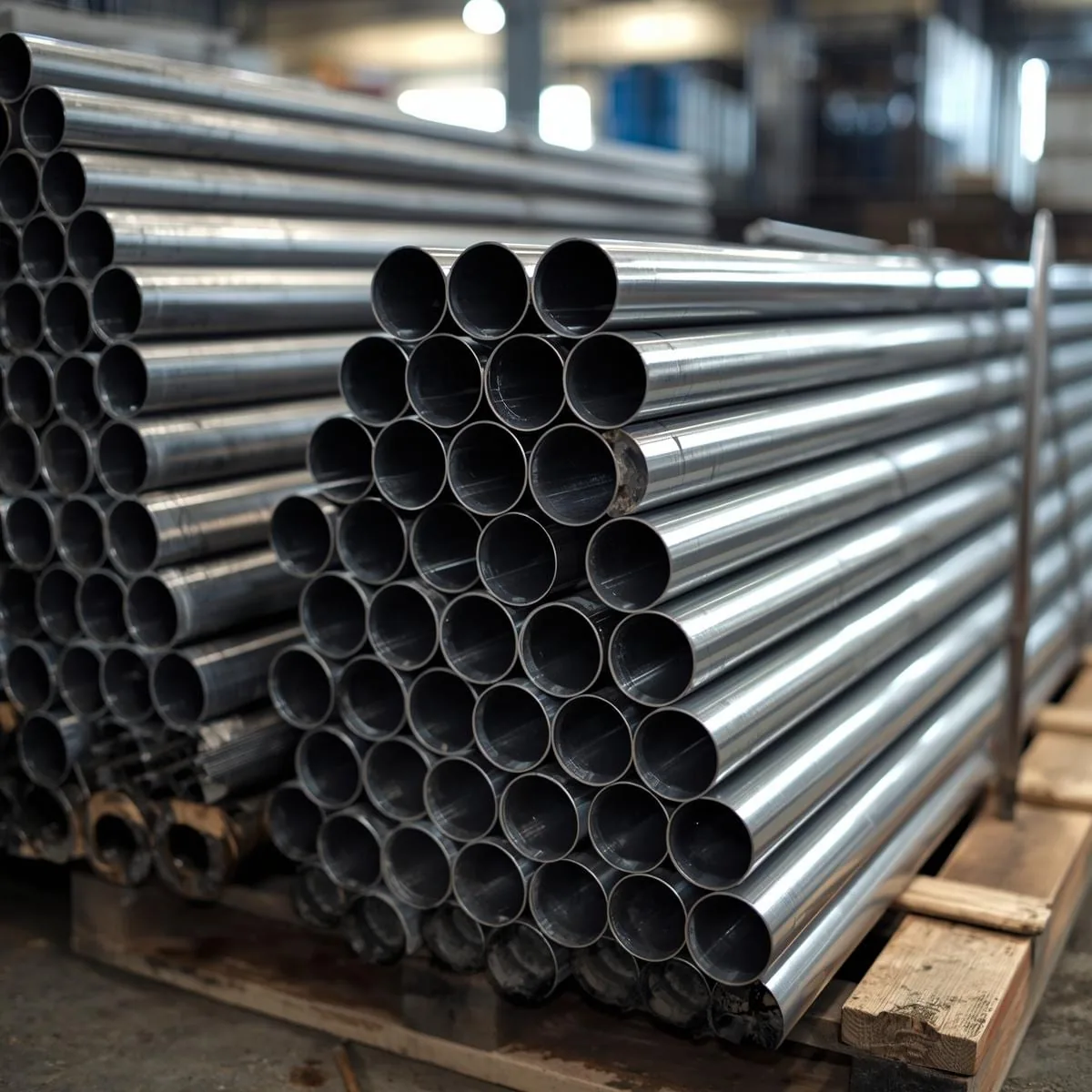
Duplex Steel Pipes: The High-Strength, Corrosion-Resistant Solution for Demanding Industrial Environments
Table of Contents:
In a North Sea oil platform, a critical seawater cooling line constructed from standard 316L stainless steel suffered catastrophic chloride-induced stress corrosion cracking (SCC) after only 14 months of operation. The failure, occurring at a weld heat-affected zone (HAZ), led to a massive leak, a 3-week production shutdown, and replacement costs exceeding $2.8M.
Analysis revealed the root cause: 316L lacks the necessary microstructural stability to resist chloride attack in warm, oxygenated seawater. The replacement solution? Duplex Steel 2205 pipes (UNS S32205/S31803), which combine the best properties of austenitic and ferritic steels. Ten years later, the duplex system remains fault-free, demonstrating the material’s superior resilience in aggressive chloride environments.
What Makes Duplex Steel Unique?
Duplex stainless steels feature a mixed ferritic-austenitic microstructure (roughly 50% ferrite, 50% austenite). This dual-phase structure delivers:
- ~2x the yield strength of standard 316L/304L.
- Exceptional resistance to stress corrosion cracking (SCC).
- Superior pitting and crevice corrosion resistance (PREN 34–45).
- Good weldability and toughness at low temperatures.
Specifications and International Standards
Duplex pipes are manufactured to rigorous global specifications ensuring dimensional accuracy, chemical purity, and mechanical performance.
- ASTM/ASME:
– ASTM A790 / ASME SA790: Seamless and welded ferritic/austenitic stainless steel pipe (most common).
– ASTM A923: Standard test method for detecting detrimental intermetallic phase in duplex steels. - UNS (Unified Numbering System):
– S32205 (Standard 2205), S31803 (older 2205 variant), S32750 (2507 Super Duplex), S32304 (2304 Lean Duplex). - DIN / EN / ISO:
– DIN 1.4462 (2205), 1.4501 (2507), 1.4362 (2304).
– EN 10216-5: Seamless tubes for pressure purposes (stainless steel).
– EN 10217-7: Welded steel tubes for pressure purposes.
| Supplier & Manufacturer | Aurico Alloys LLP |
|---|---|
| Price | INR 650 – 1,500 per kg. Indicative USD 8 – 18 per kg; quoted against grade, form, size and quantity. |
Specifications by Grade – Pipe and tube
A specification is written for a product form. The standards below are the ones that cover pipe and tube; the plate, bar and tube specifications for these grades are different documents and are listed on their own pages.
| Grade | UNS | Pipe and tube specification |
|---|---|---|
| 2205 | S32205 | ASTM A790 / A789 |
| 32750 | S32750 | ASTM A790 / A789 |
| 32760 | S32760 | ASTM A790 / A789 |
Equivalent Grades: Global Cross-Reference
Procurement teams often navigate multiple nomenclatures. The table below aligns the most common duplex grades:
| Common Name | UNS Designation | DIN/EN Number | ASTM Grade | PREN (Min) |
|---|---|---|---|---|
| Lean Duplex 2304 | S32304 | 1.4362 | ASTM A790 2304 | 24 |
| Standard Duplex 2205 | S32205 | 1.4462 | ASTM A790 2205 | 34 |
| Standard Duplex (Old) | S31803 | 1.4462 | ASTM A790 2205 | 34 |
| Super Duplex 2507 | S32750 | 1.4410 | ASTM A790 2507 | 42 |
| Super Duplex Zeron 100 | S32760 | 1.4501 | ASTM A790 S32760 | 43 |
Chemical Composition
The balanced chemistry of duplex steels is critical to maintaining the 50/50 phase ratio. Deviations can lead to embrittlement or reduced corrosion resistance.
Standard Duplex 2205 (UNS S32205):
- Chromium (Cr): 22.0–23.0% (Provides pitting resistance and ferrite stability).
- Nickel (Ni): 4.5–6.5% (Promotes austenite formation; higher than 316L’s 10-14% is not needed due to N).
- Molybdenum (Mo): 3.0–3.5% (Enhances crevice corrosion resistance).
- Nitrogen (N): 0.14–0.20% (Critical austenite stabilizer; significantly boosts yield strength and PREN).
- Carbon (C): ≤0.030% (Minimizes carbide precipitation during welding).
Super Duplex 2507 (UNS S32750): Increases Cr (24-26%), Mo (3-5%), and N (0.24-0.32%) for extreme corrosion environments.
Mechanical and Physical Properties
Duplex 2205 offers nearly double the yield strength of 316L, allowing for thinner wall schedules (weight savings) in pressure applications.
| Property | Duplex 2205 (S32205) | Super Duplex 2507 (S32750) | 316L (Austenitic) |
|---|---|---|---|
| Yield Strength (0.2% offset) | ≥450 MPa (65 ksi) | ≥550 MPa (80 ksi) | ≥170 MPa (25 ksi) |
| Tensile Strength | ≥620 MPa (90 ksi) | ≥795 MPa (115 ksi) | ≥485 MPa (70 ksi) |
| Elongation | ≥25% | ≥15% | ≥30% |
| Hardness (Rockwell B) | ≤290 HB | ≤310 HB | ≤217 HB |
| Density | 7.8 g/cm³ | 7.8 g/cm³ | 8.0 g/cm³ |
| Thermal Conductivity | 14 W/m·K | 13 W/m·K | 16 W/m·K |
The high yield strength allows engineers to reduce pipe wall thickness by ~30% compared to 316L, resulting in significant weight reduction for offshore structures and lower shipping costs.
Mechanical and Physical Properties
Duplex 2205 offers nearly double the yield strength of 316L, allowing for thinner wall schedules (weight savings) in pressure applications.
| Property | Duplex 2205 (S32205) | Super Duplex 2507 (S32750) | 316L (Austenitic) |
|---|---|---|---|
| Yield Strength (0.2% offset) | ≥450 MPa (65 ksi) | ≥550 MPa (80 ksi) | ≥170 MPa (25 ksi) |
| Tensile Strength | ≥620 MPa (90 ksi) | ≥795 MPa (115 ksi) | ≥485 MPa (70 ksi) |
| Elongation | ≥25% | ≥15% | ≥30% |
| Hardness (Rockwell B) | ≤290 HB | ≤310 HB | ≤217 HB |
| Density | 7.8 g/cm³ | 7.8 g/cm³ | 8.0 g/cm³ |
| Thermal Conductivity | 14 W/m·K | 13 W/m·K | 16 W/m·K |
The high yield strength allows engineers to reduce pipe wall thickness by ~30% compared to 316L, resulting in significant weight reduction for offshore structures and lower shipping costs.
Applications by Industry: Why Duplex is Chosen
Oil & Gas (Upstream, Midstream, Downstream)
The primary driver for duplex adoption. Used in subsea pipelines, risers, umbilicals, and seawater injection systems. Its resistance to chloride SCC and hydrogen-induced cracking (HIC) makes it the only viable alternative to expensive nickel alloys in sour service (H₂S present). NACE MR0175/ISO 15156 compliance is standard.
Chemical Processing
Selected for mixing tanks, reactors, and piping handling chlorides, organic acids, and weak inorganic acids. Superior to 316L in environments where pitting and crevice corrosion are risks, yet more cost-effective than 6% Mo austenitics or C-276.
Marine and Offshore
Ballast systems, firewater lines, condenser tubes, and desalination plants. Duplex 2205 outperforms 316L in warm, stagnant seawater, and Super Duplex 2507 is used in the most aggressive deep-water applications.
Power Generation
Flue gas desulfurization (FGD) systems, cooling water circuits, and high-pressure feedwater heaters. The high strength reduces vibration and supports longer spans in power plant piping.
Pharmaceutical and Food & Beverage
While 316L is common, Lean Duplex 2304 is increasingly used for large-diameter process lines and CIP (Clean-in-Place) systems where high strength and good hygiene are required, offering a lower cost alternative with better SCC resistance.
Comparison: Duplex 2205 vs. Common Alternatives
Decision-makers often weigh the ~20–30% premium over 316L against lifecycle savings.
| Parameter | Duplex 2205 | 316L Stainless | Super Duplex 2507 | Inconel 625 |
|---|---|---|---|---|
| Yield Strength | 450 MPa | 170 MPa | 550 MPa | 415 MPa |
| PREN (Corrosion) | 34–38 | 24–26 | 42–45 | 68–72 |
| SCC Resistance | Excellent (>200°C) | Poor (>60°C) | Excellent | Excellent |
| Cost (Relative) | 1.3x 316L | 1.0x (Base) | 1.6x 316L | 4.5x 316L |
| Thermal Conductivity | Higher (~14 W/mK) | Lower (~16 W/mK) | Higher | Lowest |
EEAT: Certifications, Testing, and Export Readiness
Reputable suppliers provide comprehensive validation for global projects:
- Certifications: PED 97/23/EC, AD2000-W0, NACE MR0175/ISO 15156, ASME Section IX welding, TUV/Lloyd’s approval.
- Testing:
– Pitting Resistance: ASTM G48 Method A (Critical Pitting Temperature).
– Microstructure: ASTM A923 to detect detrimental sigma phase or chi phase.
– Weld Qualification: 100% radiography (RT) or eddy current (ET) for welded pipes.
– Hydrostatic: Tested to 2x design pressure. - Documentation: EN 10204 3.1 Mill Test Reports, full traceability to heat number, PMI (Positive Material Identification) via XRF.
For specialized jig and fixture fabrication in duplex processing lines, many OEMs also stock duplex steel hex bar of matching grade to ensure uniform performance throughout the manufacturing ecosystem.
Industry Statistics
The global duplex stainless steel market is projected to grow at a CAGR of 7.2% through 2030, driven by offshore oil & gas expansion, desalination capacity, and chemical plant upgrades. The Oil & Gas sector accounts for ~45% of duplex pipe consumption, with the Middle East and North Sea being the largest adoption regions. Over 60% of new subsea pipelines launched in 2024 utilized duplex 2205 or Super Duplex 2507 due to their weight and corrosion advantages.
Frequently Asked Questions (FAQs)
What is the key difference between S32205 and S31803?
Can duplex steel pipes be welded using standard 316L filler metal?
What is the maximum service temperature for duplex 2205?
Why is nitrogen added to duplex steel compositions?
Global Export Destinations
We ship worldwide from Mumbai. See every destination we export to on our export markets page.
Domestic Supply Network
We deliver across India from our Mumbai stockyard. See every city we supply on our supply locations page.
Conclusion
Choosing Duplex Steel Pipes is a strategic decision that balances superior mechanical strength, exceptional corrosion resistance, and lifecycle cost efficiency. With verified compliance to UNS S32205/S31803ASTM A790, and DIN 1.4462, and supported by rigorous testing (ASTM A923, NACE), duplex steel delivers unmatched reliability in the world’s most aggressive industrial environments. From subsea oil & gas lines to chemical reactors, it is the material that keeps critical infrastructure running safely and efficiently.