Titanium Grade 7 Plates | Ti‑0.15Pd Alloy for the Toughest Chloride & Acid Service
Table of Contents:
A coastal chemical plant running hot hydrochloric and sulphuric acid scrubbers had already upgraded from 316L to commercially pure titanium, yet tight flange gaps and gasket interfaces in the absorber still showed crevice attack after each shutdown. When the integrity team rebuilt the critical liner, baffles and flange rings in Titanium Grade 7 Plates (Ti‑0.15Pd, UNS R52400), exposure tests showed that the small palladium addition drove crevice and pitting resistance far beyond non‑alloyed titanium in chloride‑rich reducing acids, and plant inspections over multiple campaigns reported bright, intact titanium where the previous plates had suffered measurable metal loss.
Titanium Grade 7 is an unalloyed titanium modified with a small palladium addition of roughly 0.12–0.25% by weight (Ti‑0.15Pd), giving it mechanical and physical properties very similar to Grade 2 but with much higher resistance to reducing acids and localised attack in hot halide media. The alloy carries UNS R52400 and material number 3.7235, and products such as strip, sheet and plate are covered by ASTM B265 / ASME SB‑265 Grade 7, with Grade 7H defined in the same standard as a higher‑strength variant requiring a minimum ultimate tensile strength of about 400 MPa (58 ksi).
For procurement heads, process and corrosion engineers, fabricators, OEMs and hardware or industrial supply stores in chemical, oil & gas, marine, pharma and power generation, Titanium Grade 7 plates offer a way to unlock titanium’s seawater and oxidising‑media resistance while also addressing crevice corrosion and reducing‑acid exposure that challenge plain CP titanium and stainless steels. Laboratory work and industry guides show that Ti‑0.15Pd alloys outperform unalloyed grades in hydrochloric and sulphuric acids and resist crevice corrosion at temperatures and chloride levels where Grade 2 alone starts to suffer, while maintaining the low density and the yield strengths in the 275–345 MPa range typical of CP titanium plate.
Aurico Alloys LLP can support these use cases as an affordable, authentic Titanium Grade 7 Plates supplier, manufacturer and stockist in India with exports abroad, supplying plate aligned to UNS R52400 / 3.7235 ranges and ASTM B265 Grade 7 mechanical requirements with EN 10204 test certificates for global projects.
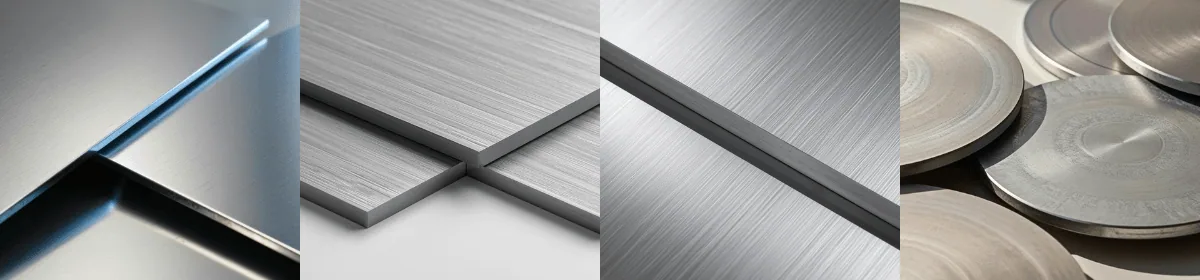
High-quality Titanium Grade 7 Plates ready for industrial use.
Specification Overview
| Supplier & Role | Aurico Alloys LLP – Titanium Grade 7 Plates supplier, stockist, exporter in India to abroad |
|---|---|
| Alloy Description | Unalloyed titanium with 0.12–0.25% palladium (Ti‑0.15Pd), mechanically similar to Grade 2 but with enhanced corrosion resistance |
| UNS / Werkstoff / EN | UNS R52400, 3.7235; often denoted Ti‑0.15Pd or Ti‑2Pd in datasheets |
| Main Plate Standards | ASTM B265 / ASME SB‑265 Grade 7 for strip, sheet and plate; Grade 7H variant with higher minimum UTS also defined |
| Thickness Range | 4.75 mm – 150 mm |
| Corrosion Focus | Exceptional resistance to reducing acids, localised attack in hot halide media and crevice corrosion in chloride‑rich environments, in addition to standard titanium seawater resistance |
| Price | INR 10,000 – 25,000 per kg. Indicative USD 118 – 294 per kg; quoted against grade, form, size and quantity. |
UNS & Equivalent Grades
| Property | Value |
|---|---|
| UNS number | R52400 |
| Werkstoff / EN number | 3.7235 |
| Density | 4.51 g/cm3 |
| Melting range | 1650 °C |
| Modulus of elasticity | 15 × 10⁶ psi |
| Beta transus | 1635-1735 °F (ATI range for grades 1-4 7 11 12 and 16-18 (± 25 °F)) |
| Thermal conductivity | 13-10 Btu/ft·h·°F (ATI range for grades 1-4 7 11 12 and 16-18) |
| Coefficient of expansion (32-600 °F) | 5.1 µin/in·°F |
| Plate, sheet and strip specification | ASTM B265 |
Identifiers and physical constants for Titanium Grade 7. A dash means no such designation is published for this grade.
Stock & Product Availability
As a Titanium Grade 7 Plates stockist, Aurico Alloys LLP can supply plate and sheet thicknesses suitable for absorber linings, scrubber shells, tube sheets, channel covers, hot brine boxes and structural plates in chemical, oil & gas, marine, pharma and power plants, within the dimensional ranges normally covered by ASTM B265 Grade 7. Plates are typically supplied in annealed condition for good formability and weldability, with cut‑to‑size, profile cutting and edge preparation services that help fabricators and OEMs reduce machining and fit‑up time while maintaining heat‑number traceability.
Chemical Composition
| Element | Min (%) | Max (%) |
|---|---|---|
| Carbon (C) | — | 0.08 |
| Oxygen (O) | — | 0.25 |
| Nitrogen (N) | — | 0.03 |
| Hydrogen (H) | — | 0.015 (product analysis - ingot analysis for all other elements) |
| Iron (Fe) | — | 0.30 |
| Palladium (Pd) | 0.12 | 0.25 |
| Other elements (each) | — | 0.1 |
| Other elements (total) | — | 0.4 |
| Titanium (Ti) | — | Balance (determined by difference) |
Composition limits for Titanium Grade 7. These are specification limits for the grade, not measured values for a lot; the mill test certificate supplied with your order states the actual analysis.
Mechanical & Physical Properties
| Property (Room Temperature, Annealed Plate) | Typical Value – Titanium Grade 7 |
|---|---|
| Ultimate Tensile Strength | Typical ≈480–500 MPa (≈70 ksi), similar to Grade 2; Grade 7H minimum ≈400 MPa per ASTM B265 |
| Yield Strength (0.2% offset) | Typical ≈275–345 MPa (≈40–50 ksi) |
| Elongation | Typical ≈20–28% in 50 mm gauge length |
| Modulus of Elasticity | ≈110–112 GPa (≈16 × 10³ ksi) |
| Coefficient of Thermal Expansion | ≈9.7 µm/m·°C between 20–500 °C |
| Thermal Conductivity | On the order of 13 W/m·K at room temperature |
| Corrosion Behaviour | Highly resistant to reducing acids and localised corrosion in hot chloride media; superior seawater and brine resistance compared with non‑Pd grades |
Applications & Benefits
- Chemical & Oil & Gas: Titanium Grade 7 plates are widely used in scrubbers, absorbers, heat‑exchanger plates, tube sheets, reactor linings and piping components handling hydrochloric, sulphuric and other reducing or mixed acids where palladium‑enhanced resistance to crevice and pitting attack is crucial for uptime.
- Marine & Power Generation: In hot seawater, brine, flue‑gas desulfurization and once‑through cooling systems, Ti‑0.15Pd plate maintains negligible corrosion rates and resists crevice damage even at elevated temperatures and chlorides, while stainless steels and some CP titanium grades may require more conservative design.
- Pharma & High‑Purity Systems: Grade 7 can be selected for high‑purity or pharmaceutical waste‑treatment and off‑gas systems where reducing acid cleaning regimes and chloride traces would challenge other alloys yet ultra‑low corrosion and metal ion release are needed.
FAQ & Search Trends
Global Export Destinations
We ship worldwide from Mumbai. See every destination we export to on our export markets page.
Domestic Supply Network
We deliver across India from our Mumbai stockyard. See every city we supply on our supply locations page.
Conclusion
Titanium Grade 7 Plates from Aurico Alloys LLP, supplied to UNS R52400 / 3.7235 chemistry limits and ASTM B265 Grade 7 mechanical requirements, give chemical, oil & gas, marine, pharma and power‑generation users a palladium‑alloyed titanium plate solution that combines the strength and weldability of Grade 2 with exceptional resistance to reducing acids, chlorides and seawater are your most critical scrubbers, absorbers, brine circuits and seawater‑facing structures still relying on less resistant materials instead of optimised Titanium Grade 7 plates?