Titanium & Titanium Alloy Wire: Standards, Properties, and Industrial Applications
Engineered for extreme corrosion resistance and strength in demanding environments.
Table of Contents:
At a coastal desalination plant, stainless fastener wire and lockwire in the high-pressure rack began to fail by crevice attack under deposits within two seasons, and each unplanned isolation cost more in lost permeate than the entire fastener package was worth. The rebuild specified titanium Grade 2 wire instead: titanium carries a passive oxide film that re-forms on contact with oxygenated seawater, so it does not pit or crevice-corrode in ambient chloride service, and it is immune to the chloride stress-corrosion cracking that ends most stainless installations on the coast.
Specifications and Standards
Titanium wire is supplied to ASTM B863, the specification covering titanium and titanium alloy wire in Grades 1, 2, 5, 9 and 23. B863 sets the chemistry, tensile requirements, tolerances and permitted surface condition for drawn wire. The flat and long products of the same grades fall under ASTM B265 (strip, sheet and plate) and B348 (bars and billets); those are separate specifications and are not interchangeable with it.
Wire supplied for welding is classified under AWS A5.16 as ERTi-1, ERTi-2, ERTi-5, ERTi-9 and ERTi-23, with AMS 4951 and AMS 4954 covering the Grade 2 and Ti-6Al-4V filler grades. Where the wire goes into surgical implants, ASTM F67 covers unalloyed titanium and ASTM F136 covers Ti-6Al-4V ELI. DIN and EN equivalents follow the Werkstoff numbers listed below, and every coil ships with EN 10204 3.1 certification for traceability.
Specifications by Grade – Wire
A specification is written for a product form. The standards below are the ones that cover wire; the plate, bar and tube specifications for these grades are different documents and are listed on their own pages.
| Grade | UNS | Wire specification |
|---|---|---|
| Grade 1 | R50250 | ASTM B863 |
| Grade 2 | R50400 | ASTM B863 |
| Grade 5 | R56400 | ASTM B863 |
| Grade 7 | R52400 | ASTM B863 |
| Grade 9 | R56320 | ASTM B863 |
| Grade 11 | R52250 | ASTM B863 |
| Grade 12 | R53400 | ASTM B863 |
| Grade 23 | R56407 | ASTM B863 |
| Ti-6-2-4-2 | R54620 | Mill specification |
| Ti-6Al-7Nb | R56700 | ASTM F1295 |
Equivalent Grades
| Grade | UNS | Werkstoff | Welding classification | Character |
|---|---|---|---|---|
| Titanium Grade 1 | R50250 | 3.7024 | ERTi-1 | Commercially pure, softest, most formable |
| Titanium Grade 2 | R50400 | 3.7035 | ERTi-2 | Commercially pure, the general-purpose grade |
| Titanium Grade 5 (Ti-6Al-4V) | R56400 | 3.7165 | ERTi-5 | Alpha-beta alloy, highest strength |
| Titanium Grade 9 (Ti-3Al-2.5V) | R56320 | 3.7195 | ERTi-9 | Half-strength alloy, cold formable |
| Titanium Grade 23 (Ti-6Al-4V ELI) | R56407 | 3.7165 ELI | ERTi-23 | Extra-low interstitial, implant and cryogenic |
The Werkstoff numbers let procurement teams cross-reference European mill certificates against an ASTM B863 order without requalifying the material.
Product Forms and Availability
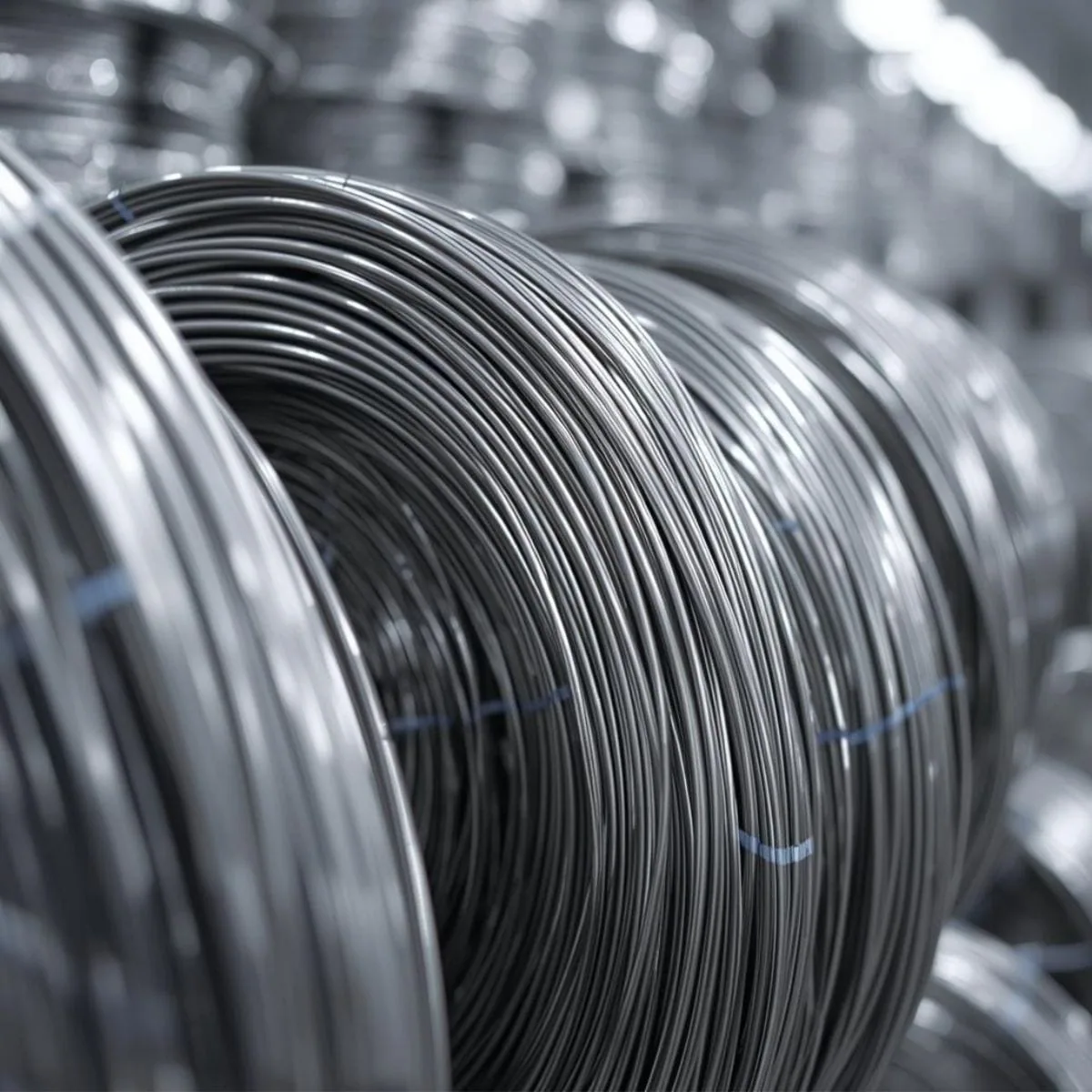
Titanium wire is stocked in round diameters from 0.10 mm to 12 mm, supplied on spools, in coils, or cut to straight lengths. TIG filler rod is cut to 1000 mm in 1.0 mm to 4.0 mm diameters; MIG and cold-wire feed spools are wound for continuous feed. Flat and profile wire is drawn to order.
Surface conditions include bright drawn, pickled and vacuum annealed. Welding-grade wire is supplied cleaned and degreased, because titanium picks up oxygen, nitrogen and hydrogen readily at welding temperature and surface contamination shows up directly as weld embrittlement.
For heavier sections in the same grades, see titanium hollow bars and titanium hex bars.
Chemical Composition
The commercially pure grades are separated by their permitted interstitial content rather than by alloying. Grade 1 (R50250) allows O 0.18% max, Fe 0.20% max, C 0.08% max, N 0.03% max and H 0.015% max, balance titanium. Grade 2 (R50400) allows O 0.25% max and Fe 0.30% max on the same basis, which is what gives it higher strength and slightly lower ductility than Grade 1.
Grade 5 (R56400) adds Al 5.5-6.75% and V 3.5-4.5%, with Fe 0.40% max and O 0.20% max. Grade 9 (R56320) is the leaner Al 2.5-3.5%, V 2.0-3.0% alloy. Grade 23 (R56407) is Grade 5 chemistry held to extra-low interstitial limits, O 0.13% max and Fe 0.25% max, which is what buys back fracture toughness for implant and cryogenic service.
Mechanical and Physical Properties
| Grade | Tensile strength, min | Yield strength, min | Elongation, min |
|---|---|---|---|
| Grade 1 | 240 MPa | 170 MPa | 24% |
| Grade 2 | 345 MPa | 275 MPa | 20% |
| Grade 5 | 895 MPa | 828 MPa | 10% |
| Grade 9 | 620 MPa | 500 MPa | 15% |
| Grade 23 | 828 MPa | 759 MPa | 10% |
Density is 4.51 g/cm³ for the commercially pure grades and 4.43 g/cm³ for Ti-6Al-4V, roughly half that of nickel alloys and stainless steel, and the melting point is about 1668°C. Elastic modulus runs 100-120 GPa, low enough that titanium springs store more energy per unit volume than steel springs of the same dimensions. Thermal conductivity is low, around 16-22 W/m·K for the CP grades and near 7 W/m·K for Grade 5, which is why titanium welds hold heat locally and need tight interpass control.
Applications by Industry
Chemical Processing
Titanium wire serves as anode and mesh stock in chlor-alkali and electrochemical cells, and as filler for weld overlays and repairs in bleaching, chlorine dioxide and wet chloride service where stainless and even nickel alloys pit. Grade 2 covers most duty; the palladium-stabilised Grade 7 and Grade 11 are specified where reducing acids are present.
Oil & Gas
Springs, seal wire, lockwire and downhole instrument components in sour service use titanium because it is not subject to sulphide stress cracking, and the strength-to-weight ratio matters directly in long deployed strings. Grade 5 and Grade 23 cover the load-bearing items.
Marine
Seawater fasteners, mousing and lockwire, aquaculture mesh and desalination hardware use Grade 2 wire, which is immune to crevice and pitting attack in ambient seawater and needs neither cathodic protection nor coating maintenance.
Pharma
Grade 23 ELI wire to ASTM F136 goes into surgical implants, orthopaedic cerclage and dental components, where the extra-low interstitial chemistry and biocompatibility are both mandatory. Process equipment uses Grade 2 for its resistance to hot chlorides and clean-in-place chemistry.
Power Generation
Condenser tube plugs, retubing filler wire and seawater-cooled heat exchanger repairs use Grade 2 titanium wire, which welds to the titanium tubing already installed in coastal and once-through cooling plant.
Titanium Wire vs. Common Alternatives
| Property | Titanium Grade 2 | Stainless Steel 316 | Monel 400 |
|---|---|---|---|
| Density | 4.51 g/cm³ | 8.0 g/cm³ | 8.8 g/cm³ |
| Ambient seawater | Immune to pitting and crevice attack | Pits and crevice-corrodes under deposits | Good in flowing seawater |
| Chloride stress-corrosion cracking | Immune | Susceptible above about 60°C | Resistant |
| Reducing acids | Poor unless Pd-stabilised (Gr 7/11) | Moderate | Good in hydrofluoric and sulphuric |
| Cost | High | Low | Medium-high |
Titanium wins on weight and on chloride service; it loses to nickel-copper and nickel-molybdenum alloys in reducing acids, where its passive film cannot re-form. Choose on the corrodent, not on the alloy's general reputation.
Quality Assurance and Compliance
Wire is supplied with EN 10204 3.1 mill test certificates covering chemistry, tensile properties and dimensional conformance to ASTM B863, with hydrogen analysis reported because hydrogen pickup during pickling is the usual cause of embrittlement in service. Implant-grade material carries ASTM F136 certification and full melt traceability. Export packing, ISO-certified processing and cut-to-length service are available ex-stock from Mumbai.
Frequently Asked Questions
What standards govern titanium wire?
ASTM B863 is the wire specification and covers Grades 1, 2, 5, 9 and 23. AWS A5.16 classifies the same grades as welding wire (ERTi-1 through ERTi-23), and ASTM F67 and F136 apply where the wire goes into surgical implants. ASTM B265 and B348 cover flat and bar product, not wire.
What are typical diameters for titanium wire?
0.10 mm to 12 mm round, on spools, in coils or cut to straight lengths, with 1.0-4.0 mm TIG rod cut to 1000 mm. Flat and profile wire is drawn to order in bright, pickled or vacuum annealed condition.
Why choose titanium wire for seawater and chloride service?
Titanium carries a passive oxide film that re-forms instantly in oxygenated water, so it does not pit or crevice-corrode in ambient seawater and is immune to chloride stress-corrosion cracking. That removes the failure mode that ends most stainless installations in coastal and desalination plant.
How does Grade 2 wire compare with Grade 5?
Grade 2 is commercially pure: 345 MPa minimum tensile, highly formable, and the default for corrosion duty. Grade 5 (Ti-6Al-4V) reaches 895 MPa minimum tensile for load-bearing parts but is harder to cold form and needs more care when welding. Grade 9 sits between the two, and Grade 23 is Grade 5 held to lower interstitials for toughness.
Global Export Destinations
We ship worldwide from Mumbai. See every destination we export to on our export markets page.
Domestic Supply Network
We deliver across India from our Mumbai stockyard. See every city we supply on our supply locations page.
Conclusion
With adherence to ASTM B863, DIN, EN standards and proven properties, titanium alloy wire delivers unmatched reliability for procurement heads, fabricators, and OEMs in harsh industries. Rigorous testing and certifications build long-term confidence in your supply chain.
Ready to specify titanium wire for your next project?