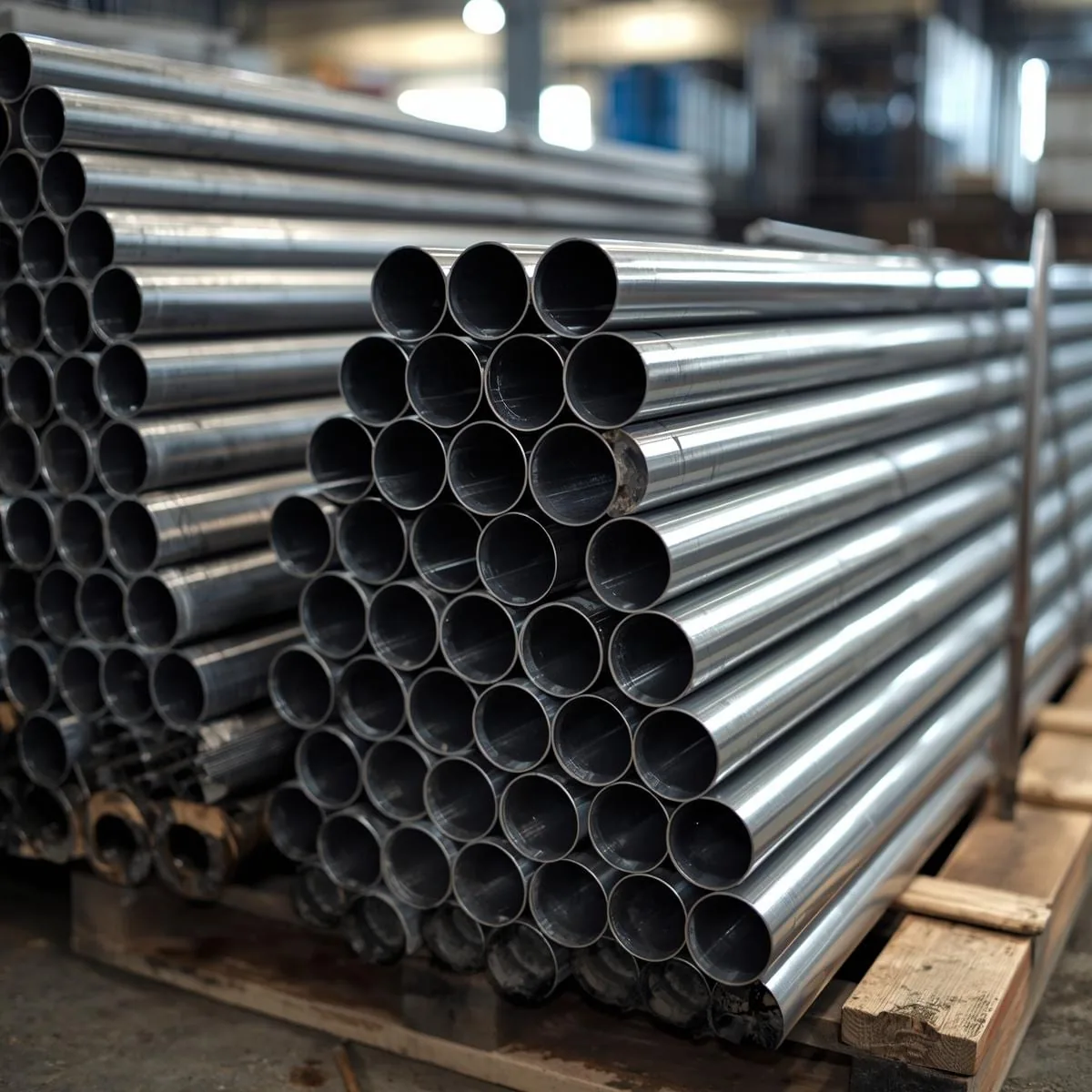
Titanium & Titanium Alloy Tube for Critical Corrosive Service
Table of Contents:
A global chemical plant recently reported premature failure in stainless steel condenser tubes after only three seasons of operation in a mixed chloride and organic acid stream, forcing an unplanned shutdown and expensive emergency retubing.
The post‑failure analysis pointed to under-deposit corrosion and stress corrosion cracking driven by high chlorides and elevated temperatures where austenitic grades were simply pushed beyond their safe operating envelope.
When the plant upgraded to ASTM B338 titanium alloy tubes, leakage stopped, inspection intervals extended, and thermal performance stabilised, turning a chronic reliability issue into a predictable, maintainable asset.
This is why procurement heads, OEM designers, and fabricators in chemical processing, oil & gas, marine, pharma, and power generation increasingly put titanium and titanium alloy tubes on their shortlists when evaluating lifetime cost rather than only initial price.
Specifications by Grade – Pipe and tube
A specification is written for a product form. The standards below are the ones that cover pipe and tube; the plate, bar and tube specifications for these grades are different documents and are listed on their own pages.
| Grade | UNS | Pipe and tube specification |
|---|---|---|
| Grade 1 | R50250 | ASTM B338 / B861 |
| Grade 2 | R50400 | ASTM B338 / B861 |
| Grade 5 | R56400 | ASTM B338 / B861 |
| Grade 7 | R52400 | ASTM B338 / B861 |
| Grade 9 | R56320 | ASTM B338 / B861 |
| Grade 11 | R52250 | ASTM B338 / B861 |
| Grade 12 | R53400 | ASTM B338 / B861 |
| Grade 23 | R56407 | ASTM B338 / B861 |
Product Forms, Sizes & Availability
Titanium and titanium alloy tubes are produced in seamless and welded forms, with hot and cold finishing routes depending on grade and final size range, under ASTM B338 and related specifications.
Supply Conditions
- Seamless tubes from hollow billets via cold drawing or cold reducing to achieve tight dimensional control and surface finish.
- Welded tubes from strip with full penetration welding and subsequent cold work and heat treatment where specified.
- Straight lengths and U‑tubes for condensers and heat exchangers, typically supplied with cleaned internal surfaces ready for fabrication.
Typical Dimensional Range
- Outside diameter from small instrumentation sizes up to large condenser tube diameters, depending on grade and production route.
- Wall thickness tailored to design pressure and corrosion allowance, aligned with ASME and project specifications.
- Length options spanning short cut pieces to long exchanger lengths, with tight cut tolerance and end conditioning for welding.
For integrated projects, tubes are often supplied alongside titanium plate, pipe, fittings, and machined parts such as titanium hex bar to ensure full material traceability across the BOM.
Frequently Asked Questions on Titanium & Titanium Alloy Tubes
Quality Assurance, Testing & Export Readiness
Buyers of titanium tubes increasingly look for mills and distributors who can demonstrate robust quality systems, traceability, and familiarity with multi‑standard projects combining ASTM, ASME, DIN, and EN requirements.
- Manufacture and supply under ASTM B338, B861, and related specifications with documented heat‑wise chemistry and mechanical test results.
- Mechanical testing to specified yield, tensile, and elongation values, along with hardness and flattening tests as required.
- NDT such as eddy current, ultrasonic or hydrostatic testing to verify leak‑tightness and integrity of tube bodies and welds.
- Dimensional inspection for OD, wall thickness, ovality, straightness, and surface finish, with EN 10204 3.1 or 3.2 certificates for export projects.
- Documentation support for ASME code stamping, PED compliance, and region‑specific regulatory requirements across Asia, Europe, and the Middle East.
With Asia Pacific accounting for roughly 40% of global titanium consumption and strong growth in India and China, exporters that can coordinate titanium tube supply from India with compliant paperwork and logistics are well positioned to serve international OEMs and EPC contractors.
Global Export Destinations
We ship worldwide from Mumbai. See every destination we export to on our export markets page.
Domestic Supply Network
We deliver across India from our Mumbai stockyard. See every city we supply on our supply locations page.
Titanium and titanium alloy tubes provide a compelling combination of corrosion resistance, high specific strength, and lifecycle cost advantages that directly address the failure modes seen in stainless and copper‑based tubing across chemical, marine, oil and gas, pharma, and power generation assets.
By specifying the right ASTM and UNS grade, aligning with applicable DIN and EN documentation, and partnering with a supplier who understands fabrication, testing, and export requirements, procurement leaders and OEM designers can convert tube bundles from recurring maintenance items into long‑term, low‑risk assets that support reliable production—are you ready to evaluate titanium tube options for your next project.