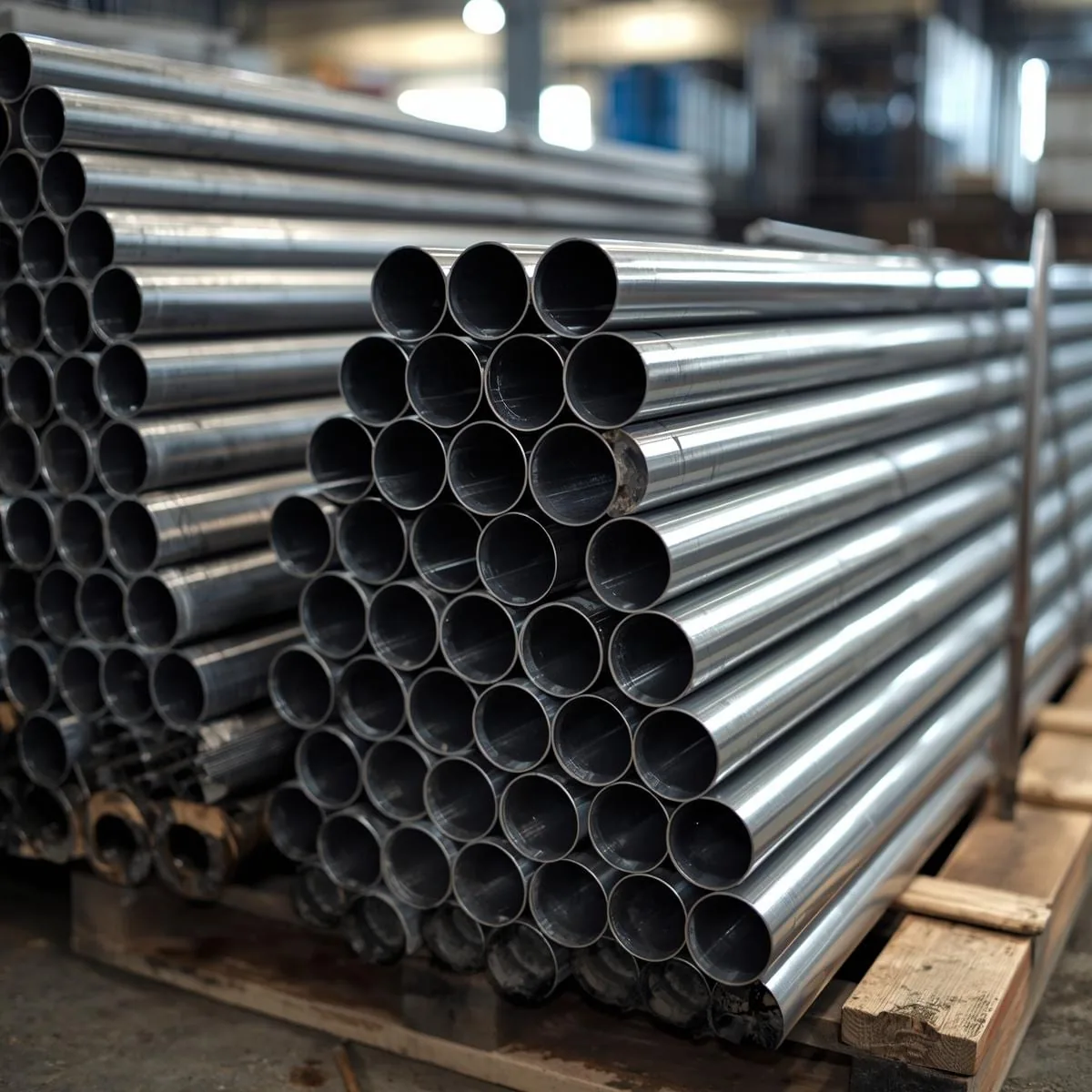
Titanium & Titanium Alloy Pipes: The Ultimate Solution for Extreme Corrosion and Weight-Sensitive Applications
Table of Contents:
In a major offshore desalination plant in the Middle East, a network of standard 316L stainless steel heat exchanger tubes failed catastrophically within 24 months due to severe pitting and crevice corrosion from hot, chlorinated seawater. The resulting shutdown cost over $4.5M in repairs and lost production, prompting a complete redesign using Titanium Grade 2 (UNS R50400) pipes, which have since operated flawlessly for over 15 years.
This case illustrates the critical need for advanced materials in aggressive environments. Titanium and its alloys offer an unmatched combination of high strength-to-weight ratio, exceptional corrosion resistance, and biocompatibility, making them the material of choice for the world’s most demanding industrial sectors.
Specifications, Standards, and Designations
Titanium pipes are manufactured and tested under a rigorous framework of international standards ensuring mechanical integrity and chemical purity.
- ASTM/ASME:
– ASTM B338: Seamless and welded pipes and tubes for condensers and heat exchangers.
– ASTM B861: Seamless pipe for general corrosion resistance and high-temperature service.
– ASTM B862: Welded pipes for general corrosion resistance. - UNS (Unified Numbering System):
– R50250 (Grade 1), R50400 (Grade 2), R50550 (Grade 3), R52400 (Grade 7), R56400 (Grade 5 / Ti-6Al-4V). - DIN / EN / ISO:
– DIN 3.7024 (Gr 1), 3.7035 (Gr 2), 3.7055 (Gr 3), 3.7165 (Gr 5).
– EN 10216-5: Seamless steel tubes for pressure purposes (Titanium section).
These standards specify tolerances for outer diameter (±0.1mm), wall thickness, and surface finish, critical for high-pressure OEM and fabricator applications.
Specifications by Grade – Pipe and tube
A specification is written for a product form. The standards below are the ones that cover pipe and tube; the plate, bar and tube specifications for these grades are different documents and are listed on their own pages.
| Grade | UNS | Pipe and tube specification |
|---|---|---|
| Grade 1 | R50250 | ASTM B338 / B861 |
| Grade 2 | R50400 | ASTM B338 / B861 |
| Grade 5 | R56400 | ASTM B338 / B861 |
| Grade 7 | R52400 | ASTM B338 / B861 |
| Grade 9 | R56320 | ASTM B338 / B861 |
| Grade 11 | R52250 | ASTM B338 / B861 |
| Grade 12 | R53400 | ASTM B338 / B861 |
| Grade 23 | R56407 | ASTM B338 / B861 |
Equivalent Grades: Global Cross-Reference
Procurement heads often navigate multiple nomenclatures. The table below aligns common designations:
| ASTM/ASME Grade | UNS Designation | DIN/EN Number | ISO Designation | Key Characteristic |
|---|---|---|---|---|
| Grade 1 | R50250 | 3.7024 | Gr 1 | Maximum ductility, formability |
| Grade 2 | R50400 | 3.7035 | Gr 2 | Best all-around corrosion resistance (Commercially Pure) |
| Grade 3 | R50550 | 3.7055 | Gr 3 | Higher strength than Gr 2 |
| Grade 7 | R52400 | 3.7235 | Gr 7 | Palladium-added for reducing acids |
| Grade 9 | R56320 | 3.7195 | Gr 9 | 3Al-2.5V: High strength, mid-range |
| Grade 5 | R56400 | 3.7165 | Gr 5 | 6Al-4V: Most widely used alloy, high strength |
Product Forms and Availability
Specialized suppliers stock a wide range of forms to support immediate project deployment:
- Seamless Pipes: Sizes 1/2" to 12" OD, schedules 10S to 80S; ideal for high-pressure hydraulic and process lines.
- Welded Pipes: Variable wall thickness, up to 24" OD; used in large-diameter seawater intake and effluent systems.
- U-Bends and Manifolds: Pre-fabricated heat exchanger bundles.
- Coil Form: For small-bore instrument tubing (1/4" to 2").
For structural fastening and specialized tooling in titanium assembly lines, many fabricators also source high-grade titanium hex bar stock to ensure material consistency across the entire project.
Chemical Composition
The performance of titanium pipes hinges on precise alloying. Unlike steel, where carbon is the primary hardener, titanium relies on alpha/beta stabilizers like Aluminum (Al) and Vanadium (V).
- Commercially Pure (Gr 2): Ti (balance), Fe ≤0.30%, O ≤0.25%, C ≤0.10%, N ≤0.03%, H ≤0.015%.
- Grade 7 (R52400): Contains 0.12–0.25% Palladium (Pd) to enhance resistance in reducing environments (e.g., hot HCl).
- Grade 5 (Ti-6Al-4V): Al 5.5–6.75%, V 3.5–4.5%, Fe ≤0.40%, O ≤0.20%.
Low interstitial content (O, N, H) is vital for maintaining weldability and preventing embrittlement in pharma and chemical processing units.
Mechanical and Physical Properties
Titanium’s superiority lies in its specific strength (strength-to-density ratio), which is double that of 316L stainless steel.
| Property | Grade 2 (UNS R50550) | Grade 5 (Ti-6Al-4V) | 316L (Stainless) |
|---|---|---|---|
| Tensile Strength (min) | 345 MPa (50 ksi) | 860 MPa (125 ksi) | 485 MPa |
| Yield Strength (0.2% offset) | 240 MPa (35 ksi) | 795 MPa (115 ksi) | 170 MPa |
| Elongation | 20% min | 10% min | 30% min |
| Density | 4.51 g/cm³ | 4.43 g/cm³ | 8.0 g/cm³ |
| Melting Point | 1604–1660°C | 1600–1660°C | 1371–1400°C |
| Thermal Conductivity | 17 W/m·K | 6.7 W/m·K | 16 W/m·K |
These properties allow for thinner wall schedules (e.g., SCH 5S or 10S) in piping systems, significantly reducing weight in offshore platforms and aircraft OEM assemblies.
Applications by Industry: Why Titanium is Chosen
Chemical Processing
Used in chlor-alkali production, sulfuric acid recovery, and organic synthesis. Titanium’s passive oxide film (TiO₂) instantly reforms in oxidizing environments, resisting pitting where 316L and 904L fail. Grade 7 is specifically selected for wet chlorine and hot acid service.
Oil & Gas (Upstream and Downstream)
Essential for subsea risers, umbilicals, and seawater cooling systems. Its resistance to chloride stress corrosion cracking (SCC) and hydrogen embrittlement makes it the only viable option for deep-water sour gas wells (H₂S present). Weight reduction lowers offshore installation costs by 15–20%.
Marine and Offshore
Propeller shafts, seawater piping, ballast systems, and desalination plant heat exchangers. Unlike cupronickel, titanium suffers no biofouling corrosion and maintains integrity in anoxic, sulfide-rich waters.
Pharmaceutical and Biotech
Selected for its absolute biocompatibility and non-contaminating surface. Used in fermentation reactors, sterile process lines, and WFI (Water for Injection) systems. The smooth, electropolished surface prevents bacterial adhesion and meets FDA/USP Class VI requirements.
Power Generation
Condenser tubes in nuclear and thermal power plants. Titanium’s resistance to erosion-corrosion from cooling water (fresh or seawater) extends equipment life from 5–7 years (to titanium) to over 30 years, drastically reducing O&M downtime.
Comparison: Titanium vs. Common Alternatives
Decision-makers often weigh the higher initial material cost against total lifecycle cost (LCC).
| Parameter | Titanium Gr 2 | 316L Stainless | Hastelloy C-276 | Cupronickel 90-10 |
|---|---|---|---|---|
| Corrosion (Seawater) | Excellent (No pitting) | Poor (Pitting/SCC) | Excellent | Good (Biofouling risk) |
| Strength (Yield) | 240 MPa | 170 MPa | 415 MPa | 140 MPa |
| Weight (vs Steel) | 44% lighter | 1.0x (Baseline) | 1.1x (Heavier) | 1.0x |
| Max Temp (Service) | ~300°C | ~400°C | ~450°C | ~150°C |
| Lifecycle Cost | Lowest (30+ yr) | High (Frequent replace) | Moderate | Moderate |
EEAT: Certifications, Testing, and Export Readiness
Suppliers in Mumbai ready for global export provide comprehensive validation:
- Certifications: PED (Pressure Equipment Directive) 97/23/EC, AD2000-W0, NACE MR0175/ISO 15156 for sour service, ASME Section IX welding qualifications.
- Testing: 100% eddy current or hydrostatic testing, PMI (Positive Material Identification) via XRF, intergranular corrosion testing (ASTM A262), and impact testing at cryogenic temperatures.
- Documentation: EN 10204 3.1 Mill Test Reports, original traceability to heat number, and non-destructive examination (NDE) logs.
For specialized tooling and jig fabrication in titanium processing, many OEMs also utilize titanium hex bar of matching grade to ensure thermal and chemical compatibility throughout the system.
Industry Statistics
The global titanium pipes market is projected to grow at a CAGR of 6.8% through 2030, driven by offshore oil & gas expansion and pharma capacity increases in Asia-Pacific. The chemical sector accounts for ~35% of industrial titanium consumption, with seawater desalination plants in the Middle East deploying over 12,000 tons of titanium heat exchanger tubing annually.
Frequently Asked Questions (FAQs)
What is the difference between Grade 2 and Grade 5 titanium pipes?
Can titanium pipes be used in reducing acids like hydrochloric acid?
Are titanium pipes compatible with stainless steel systems?
What standards govern the welding of titanium alloy pipes?
Global Export Destinations
We ship worldwide from Mumbai. See every destination we export to on our export markets page.
Domestic Supply Network
We deliver across India from our Mumbai stockyard. See every city we supply on our supply locations page.
Conclusion
Selecting the right Titanium & Titanium Alloy Pipes is not merely a material substitution; it is a strategic investment in operational continuity, safety, and long-term cost efficiency. With verified UNS/ASTM/DIN compliance, rigorous testing, and proven performance in the world’s harshest environments, titanium delivers a return on investment that conventional alloys simply cannot match for critical infrastructure.
Have you calculated the total lifecycle savings of switching to a specialized titanium piping system for your most corrosive process stream?